Default Mode Network and Hypnosis: What the Brain Does When It Quiets Down

The default mode network is one of the most talked-about systems in cognitive neuroscience, and also one of the most misunderstood. It is not a switch you need to turn off to be productive. It is a set of brain regions, including the posterior cingulate cortex, that tend to be more active when your attention turns inward rather than toward an external task [1]. Researchers first noticed these regions because they were more engaged during rest than during focused external activity [2].
Hypnosis seems to interact with this network in surprising ways. If you want a deeper dive, our guide to the default mode network and hypnosis walks through the full mechanism. But the short version is that when attention narrows and the body downshifts, the brain's relationship to its own wandering mind changes [2].
That shift is part of what makes guided audio sessions feel different from ordinary relaxation. The brain is not just resting. It appears to enter a state where self-referential chatter loosens its grip, and that opening is where new associations can form [1][2]. For anyone who has ever noticed that willpower alone is not enough to change an automatic habit, this is where the story gets interesting.
What the Default Mode Network Actually Does
The default mode network is a collection of brain regions that includes the posterior cingulate cortex, among others [1]. When you lie still with nothing in particular to do, these regions tend to be more active than when you are focused on an external task [2]. They are associated with what researchers call spontaneous conceptual thought, the mind-wandering that happens when no specific demand commands your attention [2].
This network is not your enemy. It does important work: constructing narratives about who you are, simulating social situations, and helping you make sense of your experience. The same system that lets you daydream about a future vacation also lets you replay a conversation from yesterday, sometimes over and over, long after the other person has moved on.
When the DMN runs unchecked, especially under stress, it can become the engine behind rumination loops that are hard to escape [2]. You lie down to sleep and your brain starts replaying the day. You try to focus on work and your mind drifts to a worry you thought you had already addressed. The network is doing its job, but it has no off switch built in.
Deeley and colleagues found that hypnosis and spontaneous conceptual thought at rest were subjectively and neurally distinctive [2]. In other words, the resting mind and the hypnotized mind are not the same thing, even though both involve reduced external attention. That distinction matters because it suggests hypnosis is not just a deeper form of resting. It is a different state with a different neural signature [2].
What Happens to the DMN Under Hypnosis
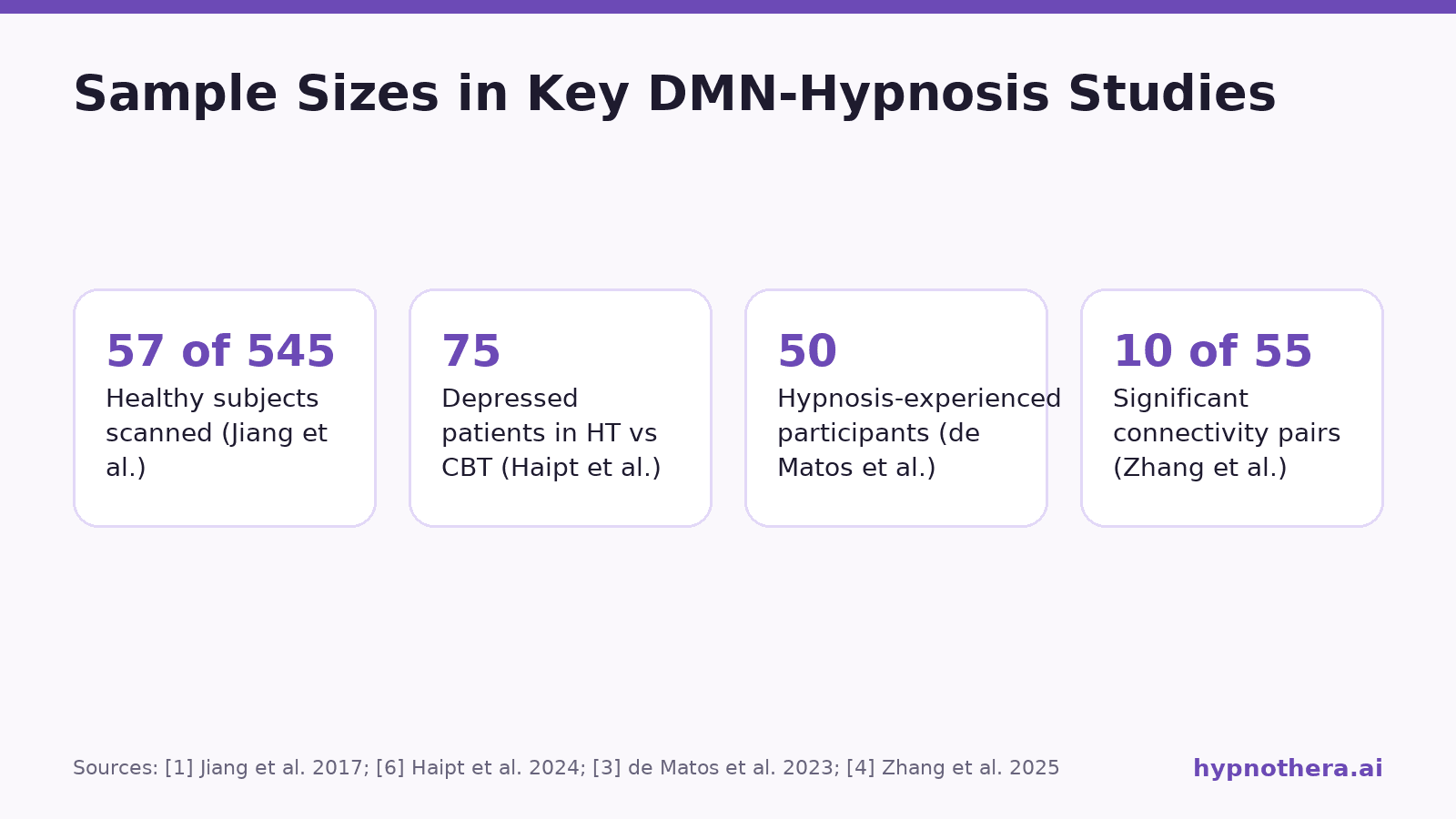
The most cited neuroimaging study on this question comes from Jiang and colleagues at Stanford, who used fMRI to scan 57 of 545 healthy subjects selected for very high or very low hypnotizability [1]. During hypnosis, they observed three key changes: reduced activity in the dorsal anterior cingulate cortex, increased functional connectivity between the dorsolateral prefrontal cortex and the insula, and reduced connectivity between the executive control network and the default mode network [1].
That last finding is the one that connects most directly to the DMN story. The executive control network and the default mode network usually operate in a see-saw relationship. When one is up, the other tends to be down. Jiang's study suggested that hypnosis may partially decouple them, allowing focused attention and somatic awareness to coexist while the self-referential chatter of the DMN quiets [1]. The researchers described these changes as underlying the focused attention, enhanced somatic and emotional control, and reduced self-consciousness that characterizes hypnosis [1].
De Matos and colleagues conducted an fMRI study with 50 hypnosis-experienced participants and used multi-voxel pattern analysis to compare hypnotic states with non-hypnotic control conditions [3]. Their analysis pinpointed key neural hubs in parieto-occipital-temporal areas, cuneal and precuneal regions, and occipital areas [3]. The precuneus is closely linked to the default mode network, which makes these findings consistent with the idea that hypnosis alters DMN-related processing rather than simply suppressing it [3].
A 2025 study by Zhang and colleagues measured 26 healthy college students using functional near-infrared spectroscopy [4]. They found statistically significant differences in functional connectivity between a control state and a hypnotic state in 10 of 55 paired comparisons across 11 regions of interest [4]. Six of those pairs showed increased connectivity during hypnosis [4]. This adds to the growing picture of hypnosis as a state that reorganizes brain network activity rather than just dampening it [4].
Not Every Brain Responds the Same Way
Hypnotic suggestibility is a fairly stable trait that varies a lot between people [5][1]. It is measured with standardized scales, and the differences between individuals are real and consistent over time [5]. The Jiang study specifically selected 57 of 545 subjects using two hypnotizability scales, choosing people with very high or very low scores [1]. That means the brain changes they observed were most pronounced in people who entered hypnosis easily.
De Pascalis's 2024 review examined brain functional correlates of resting hypnosis and hypnotizability [5]. The review supports the idea that the neural signatures of hypnosis depend on both the state and the trait [5]. Highly hypnotizable people show different patterns of brain activity during hypnosis than low-hypnotizable people do [5]. This does not mean hypnosis does not work for less suggestible people. It means the experience, and possibly the underlying brain dynamics, differ from person to person [5].
This matters for practical reasons. If you try a guided audio session and feel like nothing happened, it may reflect your baseline suggestibility rather than the quality of the session [5]. Absorption, the ability to become fully immersed in an experience, is a related trait that also varies across people [5]. People high in absorption tend to get more out of hypnotic and guided imagery work because they can drop into the imagined scene more completely [5].
The range of responsiveness is wide enough that some people drift into a deep hypnotic state within minutes while others may need several sessions to notice a shift. Neither experience is wrong. The brain data simply reminds us that hypnosis is not a one-size-fits-all phenomenon, and the same guided audio will land differently depending on who is listening.
What This Means for Depression Research
Depression is associated with abnormal functional connectivity of the default mode network [6]. This is one reason researchers have become interested in whether hypnotherapy might affect the DMN differently than other forms of therapy [6].
Haipt and colleagues conducted a study with 75 depressed patients who received either hypnotherapy or cognitive behavioral therapy, measuring resting-state brain activity before and after therapy using functional near-infrared spectroscopy [6]. On a symptom level, both groups showed significant reduction [6]. On a neurophysiological level, exploratory analyses hinted at treatment effects in two components of the DMN [6]. However, these effects did not withstand correction for multiple testing [6].
The researchers described their work as a first stepping stone in investigating the neural mechanisms of hypnotherapy [6]. The takeaway is not that hypnotherapy fixes the DMN in depression [6]. It is that researchers are beginning to ask whether hypnotherapy and CBT leave different neural signatures, even when symptom improvement looks similar on the surface [6].
The broader research landscape on hypnosis and the DMN is still young. Most studies have small samples and use different methods, from fMRI to fNIRS, which makes direct comparison difficult [5][1][3]. What the studies tend to agree on is that hypnosis is associated with measurable changes in brain network activity, even if the specifics vary across labs and individuals [5][1].
This study should not be read as a treatment recommendation. If you are dealing with depression or any clinical condition, please talk to a licensed professional. Hypnosis and guided audio can support wellbeing alongside professional care, not replace it [6].
The Practical Translation
So what does all this mean for someone who wants better sleep, more focus, or a calmer nervous system? The DMN research suggests that hypnosis may create a window where the self-referential, story-spinning part of the brain takes a back seat [1][2]. That window is where new associations can form. When the old narrative loosens its grip, even briefly, there is room to rehearse a different response to a familiar cue [1].
This is the core idea behind state preceding story. Automatic behavior is easiest to update when the nervous system downshifts, attention narrows, and the brain has a vivid, specific alternative to rehearse. Willpower arguing with a stressed body is the slowest route. A guided state that quiets the narrator and redirects attention may be faster.
Here is what you can try in under a minute:
- Pick one trigger that usually sends you into a loop, like reaching for your phone when you feel restless at night.
- Before you next face that trigger, spend 60 seconds with a guided audio session that narrows your attention to your body or to a single vivid image.
- Notice whether the urge feels different after that minute, not because you fought it, but because your state shifted.
- Repeat the pattern a few times across several days and observe what changes in the automatic response.
- If the first session feels underwhelming, try again. Hypnotic suggestibility is stable but practice still matters [5].
Key takeaways
- The default mode network is active during mind-wandering and self-referential thought, not just during rest [2].
- Hypnosis has been associated with reduced DMN activity and altered connectivity between the executive control network and the DMN [1].
- Hypnotizability varies widely between people, and the brain's response to hypnosis differs accordingly [5][1].
- Early research on hypnotherapy and depression shows symptom improvement but DMN effects that need further study [6].
- The practical move is to use guided audio to downshift, narrow attention, and rehearse an alternative state before the old cue fires [1].
If you want to experience what it feels like when the mental chatter quiets, try a Hypnothera session designed to guide you into that narrow, absorbed state. Try a guided session
Sources & Further Reading
- Jiang H, White MP, Greicius MD et al. (2017). Brain Activity and Functional Connectivity Associated with Hypnosis. Cerebral cortex (New York, N.Y. : 1991). https://doi.org/10.1093/cercor/bhw220
- Deeley Q, Oakley DA, Toone B et al. (2012). Modulating the default mode network using hypnosis. The International journal of clinical and experimental hypnosis. https://doi.org/10.1080/00207144.2012.648070
- de Matos N, Staempfli P, Seifritz E et al. (2023). Investigating functional brain connectivity patterns associated with two hypnotic states. Frontiers in Human Neuroscience. https://doi.org/10.3389/fnhum.2023.1286336
- Zhang Z, Tan W, Ma Y et al. (2025). Study on resting-state functional connectivity characteristics under hypnosis using functional near-infrared spectroscopy. Frontiers in Psychology. https://doi.org/10.3389/fpsyg.2025.1567526
- De Pascalis V (2024). Brain Functional Correlates of Resting Hypnosis and Hypnotizability: A Review. Brain Sciences. https://doi.org/10.3390/brainsci14020115
- Haipt A, Rosenbaum D, Fuhr K et al. (2024). Differential effects of hypnotherapy and cognitive behavioral therapy on the default mode network of depressed patients. Frontiers in Psychology. https://doi.org/10.3389/fpsyg.2024.1401946
Related Posts
The Science Behind Visualization for Sports Performance and How Self-Hypnosis Can Help
Hypnothera vs Hypnova vs Intropi: How Personalized AI Hypnosis Apps Compare in 2026
Hypnothera, Hypnova, and Intropi compared: script editing before you listen, custom session length (2–90 min vs 10–25 min buckets), free plans, voices, and Web, iOS, and Android availability. Checked October 2026.
NSDR vs Self-Hypnosis vs Yoga Nidra: What the Research Actually Shows
NSDR and yoga nidra support passive, targetless recovery with wide attention. Self-hypnosis narrows attention onto a chosen suggestion. Here’s what the fMRI, sleep, and trial research says about each.