Why Your Brain Remembers Differently Depending on Your State

You walk into your kitchen and forget why. You go back to your desk, and the reason returns. Most people chalk this up to distraction, but there is a deeper layer: your brain was in a different state in each location, and that state change quietly disrupted recall.
This is called state-dependent memory, and it is one of the most replicated quirks in cognitive psychology. What you learn in one physiological state—tired, relaxed, aroused, slightly intoxicated—you tend to retrieve better when you return to a similar state. The finding is not a parlor trick. It tells us something important about how the nervous system tags and files experience.
If you use guided self-hypnosis sessions to shift your state before working on a habit or a belief, state-dependent recall is worth understanding. It explains why the insights you reach in a relaxed, absorbed state do not always feel accessible when you are stressed at your desk the next morning—and what you can do about it.
What State-Dependent Memory Actually Means
State-dependent learning is the observation that material learned while your body and brain are in a particular state is recalled more effectively when you return to that same state. The 'state' can be produced by a substance, an activity, an emotional condition, or a level of physiological arousal. The key idea is that the internal context at the time of encoding becomes part of the memory trace itself.
This is different from context-dependent memory, which refers to external cues like the room you were in or the music playing. State-dependence is about what is happening inside you. Your brain does not store information in a vacuum. It stores information along with a snapshot of the physiological conditions present when that information was encoded.
When you try to retrieve the memory later, that internal snapshot acts as a retrieval cue. If your current state matches the original encoding state, the cue aligns and recall tends to flow. If the state is very different, retrieval can feel sluggish or incomplete, even though the memory is still stored.
The Classic Alcohol Studies
One of the earliest demonstrations of state-dependent memory in humans came from a 1969 study by Goodwin and colleagues. Male volunteers performed four memory tasks either while sober or under the effects of alcohol [1]. Twenty-four hours later they were tested again, either in the same state or a different one [1].
The results were striking for certain types of memory. In tasks measuring recall and interference, learning transfer was better when the subject was intoxicated during both sessions than when he was intoxicated only during the learning session [1]. In other words, if you learned something while intoxicated, you recalled it better while intoxicated again than while sober.
But the effect was not universal. In a task measuring recognition, transfer was not significantly affected by changing state [1]. The authors concluded that alcohol appears to produce dissociated or state-dependent effects in humans, but not all forms of memory are equally sensitive to the phenomenon [1].
A later study by Weissenborn and colleagues in 2000 refined this picture. They found that alcohol given at both encoding and retrieval specifically impairs retrieval of high-association items [2]. This suggests that state-dependence interacts with the type of material being remembered—semantically rich, highly associated content may be more vulnerable to state-based disruption than simpler material.
It Is Not Just About Substances
State-dependent memory is not limited to alcohol or drugs. Any shift in physiological arousal can create the same effect. A 1997 study by Schramke and colleagues compared state-dependent learning in younger and older adults, manipulating state by having participants either rest or exercise for five minutes [3].
This matters because it shows the effect is about arousal and internal condition, not about any particular substance. Exercise raises heart rate, changes breathing, shifts neurotransmitter activity, and alters attentional focus. Rest does the opposite. When encoding and retrieval happen in the same arousal band, recall tends to be smoother.
The practical implication is broad. If you learn a new skill while calm and relaxed, you may struggle to perform it under pressure. If you rehearse a presentation while jittery and caffeinated, you may find your flow more easily when you are in a similar state. The state is part of the memory.
- Match your rehearsal state to the state you expect to perform in when stakes are high.
- If you do creative work while relaxed, notice whether your best recall of ideas also happens in calm states.
- Be patient with yourself when you cannot retrieve something—your state may simply be mismatched, not your memory.
What This Means for Hypnosis and State Work
Hypnosis and guided self-hypnosis deliberately shift your physiological state. They downshift the nervous system, narrow attention, and create a specific internal condition that is quite different from your ordinary waking baseline. This is precisely the kind of state change that can produce state-dependent tagging of whatever you rehearse or imagine during the session.
This has an upside and a challenge. The upside is that if you regularly enter a relaxed, absorbed state for your hypnosis sessions, the suggestions and mental rehearsals you plant there may become more accessible each time you return to that state. Over repeated sessions, the state itself becomes a reliable retrieval cue.
The challenge is that the insights, feelings, and intentions you build in a deeply relaxed state may not automatically transfer to a high-stress Tuesday afternoon. This is not a failure of the session. It is how memory works. The state you were in when you encoded the new perspective is different from the state you are in when you need it.
This is why repetition matters. Re-entering the relaxed state repeatedly, even briefly, strengthens the association between that state and the material you are rehearsing. It also helps to create bridges—small reminders or cues that you can carry into your waking state to reactivate what you built in the session.
Putting It Into Practice
Understanding state-dependent memory gives you a practical lever. You do not need to force insights from a calm session into a stressful moment through sheer willpower. Instead, you can deliberately recreate a sliver of the encoding state when you need to retrieve what you worked on.
A few slow breaths, a brief body scan, or a moment of closed-eye visualization can begin to shift your state back toward the one you were in during the session. You do not need a full hypnosis session to get a partial match. Even a small shift in the direction of the original state can improve access to what you encoded there.
You can also use this in reverse. If you know you will need to perform or recall something under pressure, rehearse it in a mildly aroused state. Raise your heart rate slightly, stand up, speak aloud. Encode the material with some of the physiological activation that will be present when it counts.
The goal is not to live in one state. It is to understand that your brain files experience with a state tag attached, and to use that knowledge deliberately rather than being confused by it.
- Before an important recall moment, spend 30 seconds recreating the body state you were in when you learned or rehearsed the material.
- If you use hypnosis sessions, keep a one-word cue or image from the session and return to it briefly during the day to bridge states.
- Rehearse high-stakes material in a state that mimics the real conditions, not just in perfect calm.
- When you cannot remember something, try changing your posture, breathing, or environment before concluding the memory is gone.
Key takeaways
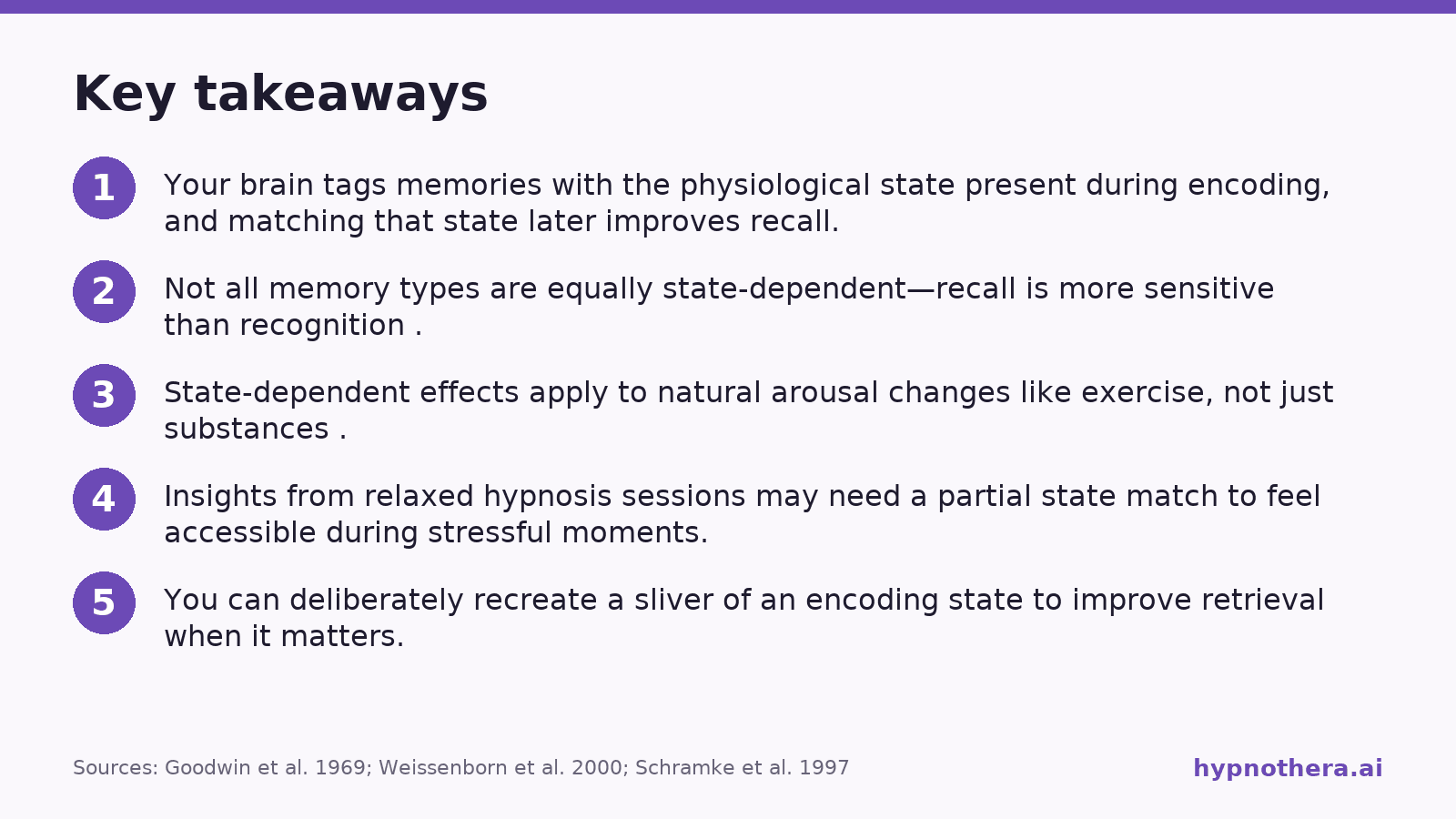
- Your brain tags memories with the physiological state present during encoding, and matching that state later improves recall.
- Not all memory types are equally state-dependent—recall is more sensitive than recognition [1].
- State-dependent effects apply to natural arousal changes like exercise, not just substances [3].
- Insights from relaxed hypnosis sessions may need a partial state match to feel accessible during stressful moments.
- You can deliberately recreate a sliver of an encoding state to improve retrieval when it matters.
If you want to experience how a deliberately shifted state changes what feels accessible, try a guided self-hypnosis session and notice what you can recall before and after. Explore self-hypnosis sessions
Sources & Further Reading
- Goodwin DW, Powell B, Bremer D et al. (1969). Alcohol and recall: state-dependent effects in man. Science (New York, N.Y.). https://doi.org/10.1126/science.163.3873.1358
- Weissenborn R, Duka T (2000). State-dependent effects of alcohol on explicit memory: the role of semantic associations. Psychopharmacology. https://doi.org/10.1007/s002139900349
- Schramke CJ, Bauer RM (1997). State-dependent learning in older and younger adults. Psychology and aging. https://doi.org/10.1037//0882-7974.12.2.255
Related Posts
Theta, Alpha, and Suggestibility: What EEG Reveals About Hypnosis
This article explores the research linking theta and alpha brainwaves to hypnotic suggestibility, explaining the slow wave hypothesis and its practical implications for self-hypnosis. It synthesizes findings from recent EEG studies to show how downshifting you
Memory Reconsolidation Windows: The Brain's Brief Edit Mode
This article explains how recalling a memory briefly makes it changeable, what the research actually shows about timing and interventions, and how guided hypnosis sessions can support that update process. Every research claim is cited to the provided sources.
Neuroplasticity and Habit Loops: How Your Brain Rewires Automatic Behavior
This article explains how the brain builds and maintains habit loops through neuroplasticity, and how you can use these mechanisms to update automatic behaviors.