Focused Attention vs Willpower: Why Narrowing Beats Forcing

Most of us know the feeling. You sit down to work, and within minutes your mind drifts to an email, a worry, or the notification light on your phone. You snap back, scold yourself, and try harder. That trying harder is willpower, and it is the most expensive fuel your brain has.
There is a different approach. Instead of forcing yourself to resist distractions, you can train the specific cognitive skill of focusing in the first place. Researchers call this focused attention, and a growing body of work suggests it can be practiced, though the evidence is more nuanced than headlines imply. If you want to explore guided sessions that put this into practice, you can try Hypnothera's focus sessions.
I studied cognitive science at Berkeley, and I am not a clinician or a lab neuroscientist. What follows is an educational look at what the research says, not medical advice.
The Willpower Trap
Willpower is the act of overriding an impulse. You feel the pull of a distraction, and you push back against it. The problem is that this push requires active cognitive resources, and those resources are finite in any given moment.
When you rely on willpower alone, you are essentially running a constant background process that checks for distractions and suppresses them. That is exhausting. It is also why people who report high self-control in daily life often are not the ones gritting their teeth the hardest. They are the ones who have arranged their environment so that fewer distractions reach conscious awareness in the first place.
The cognitive science concept here is automaticity. Habits and context cues drive behavior more powerfully than conscious intention does. When a behavior becomes automatic, it no longer requires willpower to execute. It simply fires in response to its context. The same logic applies to attention itself: if you can make focus more automatic, you spend less effort fighting distraction.
What Focused Attention Actually Is
Attention is not a single switch. Researchers distinguish between different modes. In one framework, focused attention involves narrowing your mental spotlight onto a single object or task, while distributed attention involves spreading awareness across a broader field [1]. These are not just different intensities of the same thing. They appear to involve different cognitive processes [1].
Focused attention is what you use when you read a challenging passage, follow a conversation in a noisy room, or hold a mental image steady. It is selective by nature. You are choosing one thing and implicitly choosing not to process everything else.
This matters because it reframes the problem. If you are struggling to concentrate, the issue may not be a lack of willpower but an undertrained ability to narrow and hold attention. And that ability, research suggests, may be something you can practice.
What Training Studies Actually Show
Several studies have tested whether attention can be improved through training, and the results are instructive, partly because they are mixed.
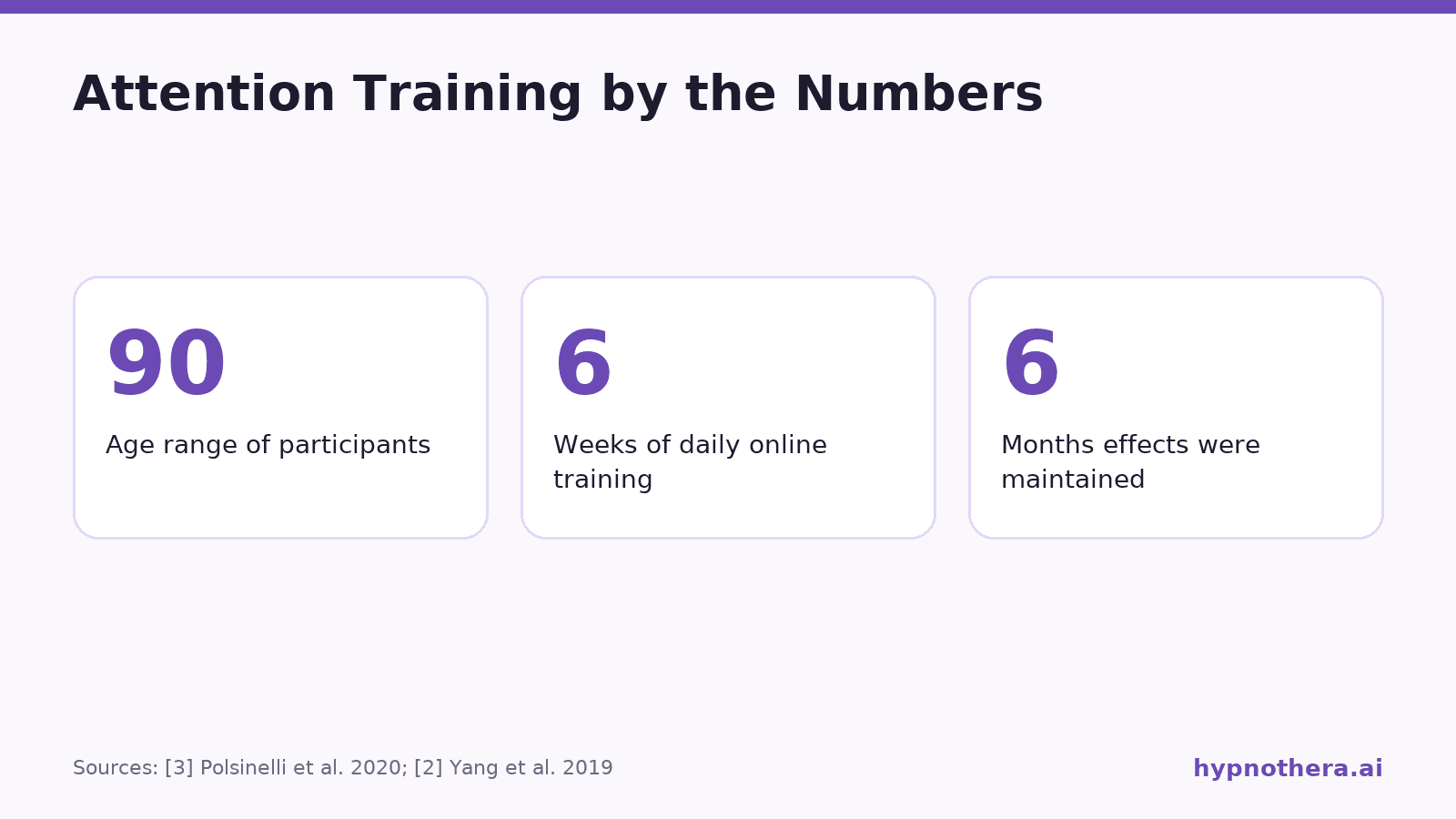
In a randomized controlled trial, Yang and colleagues constructed an executive attention training program for older adults with mild cognitive impairment. They found that the training improved selective attention and divided attention compared to an active control group, with effects maintained up to 6 months [2]. Notably, there was no significant effect on focused attention specifically in that comparison [2]. This is an honest reminder that attention is not a monolith. Training one component does not automatically improve all of them.
Polsinelli and colleagues conducted another randomized controlled trial with 50 older adults aged 65 to 90, who completed 6 weeks of online daily focused attention mindfulness training or a mind-wandering control [3]. The results were modest. Aspects of mindfulness and inhibitory control increased, but this was not specific to the mindfulness training. The control group showed similar gains [3]. There was some evidence of improved attentional control specific to the mindfulness group, but it was not consistent across the two measures used [3]. The authors concluded the results were encouraging but required replication in a larger, more diverse sample [3].
Fergus and colleagues took a different angle. They examined an attention training technique in the context of self-focused attention and anxiety, using a laboratory-based component study [4]. The study design allowed them to isolate elements of the training to see which components mattered [4]. This kind of component analysis is valuable because it moves beyond asking whether something works to asking which part of it works.
Taken together, these studies suggest that focused attention is a real, distinguishable cognitive capacity that can be studied and potentially trained [2][1][3]. But they also caution against overselling. The effects are often modest, sometimes nonspecific, and not always consistent across measures [2][3].
Why Narrowing Attention Works Differently Than Forcing It
Here is where the distinction between focused attention and willpower becomes practical. Willpower is reactive. A distraction appears, and you suppress it. Focused attention is proactive. You select a target before the distraction arrives, and your cognitive resources are already engaged.
When you narrow attention to a specific target, you are effectively telling your cognitive system what matters right now. Everything else becomes lower priority, not because you are suppressing it with effort, but because your system has already ranked it as less relevant. This is consistent with theoretical models in which the brain constantly generates predictions about incoming information and updates when those predictions do not match. Narrowing attention sets a strong prediction about what deserves processing.
In the context of hypnosis and guided audio, this is one reason why sessions often begin with attention-narrowing instructions. By directing attention to a single sensation, such as breathing, a voice, or a mental image, the nervous system shifts toward a calmer state. That state change is not decoration. It is the mechanism. When the body is less aroused, the cognitive resources needed for focus are more available because they are not being spent on threat monitoring.
This is also why arguing with yourself while stressed is the slowest route to change. A stressed body keeps attention broad and vigilant, exactly the opposite of the narrow focus you are trying to achieve. Downshifting the nervous system first, then narrowing attention, works with the grain of how attention actually operates rather than against it.
A Practice You Can Try in Under a Minute
You do not need a formal study protocol to begin. Here is a simple practice based on the principles above.
Pick one sensory target before you start. It could be the feeling of air at your nostrils, the sound of a steady tone, or the weight of your hands in your lap. Choosing before you begin is the proactive step that separates focused attention from willpower.
Narrow to that target for 30 seconds. When your mind wanders, do not scold yourself. Simply return to the target. The return is the rep, not the duration of the hold.
Notice the state shift. After a minute or two, you may notice your breathing slows and your shoulders drop. That is the downshift. It is not a bonus. It is the point.
Begin your task from this state. Do not jump straight into work. Let the narrowed, calmer state be the launching pad.
This is not meditation in the spiritual sense. It is attention training in the cognitive sense, a deliberate practice of the selective narrowing that underlies focus.
- Pick one sensory target before you begin — breath, sound, or touch
- Narrow to it for 30 seconds; the return after wandering is the rep
- Notice the state shift: slower breath, lower shoulders
- Begin your task from this calmer, narrowed state
Limits and Honest Expectations
The research on attention training is still developing. The studies cited here used small samples [3], specific populations such as older adults with mild cognitive impairment [2], and laboratory measures that may not perfectly capture real-world focus [4][2][3]. Effects were often modest and sometimes nonspecific [3]. No study showed that attention training cures anxiety, reverses cognitive decline, or guarantees productivity.
What the evidence does support is more measured. Focused attention is a distinguishable cognitive mode [1], it can be studied in controlled settings [4][2][3], and brief training may produce modest improvements in some aspects of attentional control [3]. That is enough to justify practice, but not enough to justify grand claims.
If you are dealing with persistent anxiety, significant attention difficulties, or cognitive concerns, please consult a qualified professional. Hypnosis and guided audio sessions support wellbeing. They do not treat medical conditions.
Key takeaways
- Willpower reacts to distractions after they appear; focused attention selects a target before they arrive.
- Focused and distributed attention are distinct cognitive modes, not just different intensities of the same thing [1].
- Training studies show modest, sometimes nonspecific gains in attention, not dramatic transformations [2][3].
- Narrowing attention first, then beginning a task, works with how your cognitive system prioritizes information.
- If attention problems persist or interfere with daily life, consult a qualified professional.
If you want to experience attention narrowing in a guided format, try a Hypnothera session designed specifically for focus. Try Hypnothera's focus sessions
Sources & Further Reading
- Chong SC, Evans KK (2011). Distributed versus focused attention (count vs estimate). Wiley interdisciplinary reviews. Cognitive science. https://doi.org/10.1002/wcs.136
- Yang H, Chu H, Miao N et al. (2019). The Construction and Evaluation of Executive Attention Training to Improve Selective Attention, Focused Attention, and Divided Attention for Older Adults With Mild Cognitive Impairment: A Randomized Controlled Trial. The American Journal of Geriatric Psychiatry. https://doi.org/10.1016/j.jagp.2019.05.017
- Polsinelli A, Kaszniak A, Glisky E et al. (2020). Effects of a Brief, Online, Focused Attention Mindfulness Training on Cognition in Older Adults: a Randomized Controlled Trial. Mindfulness. https://doi.org/10.1007/s12671-020-01329-2
- Fergus T, Wheless N, Wright L (2014). The attention training technique, self-focused attention, and anxiety: A laboratory-based component study. Behaviour Research and Therapy. https://doi.org/10.1016/j.brat.2014.08.007
Related Posts
Theta, Alpha, and Suggestibility: What EEG Reveals About Hypnosis
This article explores the research linking theta and alpha brainwaves to hypnotic suggestibility, explaining the slow wave hypothesis and its practical implications for self-hypnosis. It synthesizes findings from recent EEG studies to show how downshifting you
Why Your Brain Remembers Differently Depending on Your State
This article explores state-dependent learning and recall—how your internal physiological state during encoding affects what you can retrieve later. It covers classic alcohol studies, exercise-based state experiments, and what this means for hypnosis and habit
Memory Reconsolidation Windows: The Brain's Brief Edit Mode
This article explains how recalling a memory briefly makes it changeable, what the research actually shows about timing and interventions, and how guided hypnosis sessions can support that update process. Every research claim is cited to the provided sources.