Memory reconsolidation windows: the brain's brief edit mode

Most of us were taught that memories are like recordings: stored once, played back faithfully, slowly degrading over time. The reality is stranger. Every time you recall a memory, your brain briefly reopens the file. For a short window, that memory becomes changeable before it is stored again.
This process is called memory reconsolidation, and it may be one of the most useful ideas in cognitive science for anyone trying to change an automatic habit, reaction, or emotional pattern. Retrieval can bring memories to a labile state, creating a window to modify their content during reconsolidation [1].
The implications are practical. If an old memory is briefly editable when it is recalled, then the moments when a familiar pattern shows up — the tension before sleep, the flash of irritation, the automatic reach for the phone — are not just problems to push through. They are openings. Something specific has to happen inside that opening for the old pattern to update, and that is where guided hypnosis for memory work becomes relevant.
What reconsolidation actually is
For most of the twentieth century, the dominant view was that once a long-term memory is consolidated, it is fixed. Recall was thought to be read-only. Then a series of experiments began to challenge that assumption. In animal models, researchers found that retrieving a memory can return it to a state where it is once again susceptible to modification before being stored again [2].
The key insight is that remembering is not passive playback. It is an active reconstruction, and the reconstruction is briefly unstable. When you recall an old emotional reaction, the brain does not simply read the original file. It rewrites it, and what gets stored back can differ from what was retrieved if something new has been introduced in the meantime [1].
This is why the concept matters beyond the laboratory. The automatic patterns people want to change — the ones that feel locked in, resistant to willpower — are often built on emotional memories. A situation cues a learned reaction because the brain has stored an association between that context and a feeling. If the memory can be briefly opened, the association can, in principle, be updated.
That is the promise. The mechanism is real and well studied in animals, with growing evidence that similar effects occur in humans [2]. But the details — how long the window lasts, what triggers it, what has to happen inside it — are still being worked out.
- Retrieval makes a memory briefly labile, not permanently erased [1].
- The re-stored memory can incorporate new information introduced during the window [3].
- Animal evidence is strong; human replication is promising but still developing [2].
The window, and why its edges are blurry
The phrase 'reconsolidation window' suggests something clean: a defined period, like an hour or a day, during which a memory is editable. The reality is more complicated. The temporal dynamics of post-retrieval memory processes have been largely overlooked, which has led to mixed findings and hindered the development of targeted interventions [1].
Emerging evidence suggests that some mechanisms triggered after memory retrieval can influence either reconsolidation or persistence in different time windows [1]. In other words, there may not be a single window. There may be several overlapping processes, each with its own timing, and they do not always line up neatly.
This matters for anyone trying to use the mechanism practically. If you assume a fixed, known window, you can design an intervention around it. If the boundaries are unclear, the intervention has to be more forgiving — built around the principle of reactivation-plus-update rather than a precise timetable.
The honest reading of the literature is this: the window is real, but its temporal boundaries are still unclear [1]. We know retrieval opens something. We know new input during that period can shape what gets stored. We do not have a settled number for how long the door stays open, and the number may differ by memory type, emotional intensity, and individual.
This is why, in self-hypnosis and guided audio work, the emphasis is less on timing and more on sequencing. Reactivate the old pattern. Introduce a vivid, specific alternative. Let the nervous system rehearse the new version. The exact minute count matters less than whether the right ingredients are present.
Why emotional arousal is not optional
Not every recall produces reconsolidation. The memory has to be reactivated strongly enough, and something has to happen that the brain did not predict. Researchers in psychotherapy have argued that emotional arousal is a key ingredient in therapeutic change across many modalities [3]. A flat, intellectual recall is unlikely to reopen the file. A vivid, felt recall might.
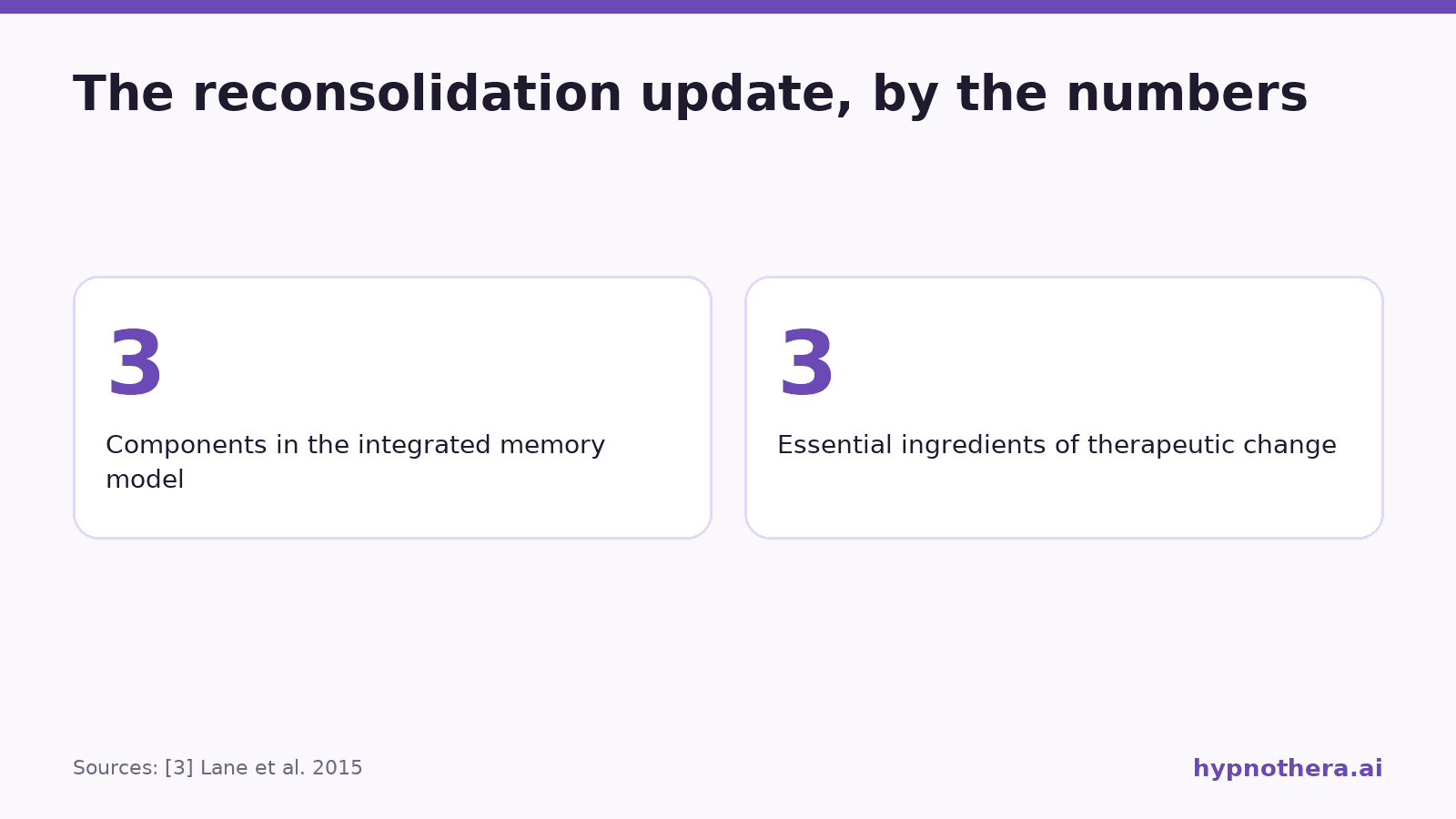
Lane and colleagues proposed an integrated memory model with three interactive components: autobiographical event memories, semantic structures, and emotional responses [3]. The components do not update independently. When a therapeutic update happens, it tends to involve all three layers — the specific memory, the meaning attached to it, and the bodily feeling it carries.
They identified three essential ingredients for therapeutic change: reactivating old memories, engaging in new emotional experiences that are incorporated into these reactivated memories via reconsolidation, and reinforcing the integrated memory structure by practicing a new way of behaving and experiencing the world in a variety of contexts [3].
Read that list carefully. It is not enough to remember the old pattern. It is not enough to feel something new. The new feeling has to land while the old memory is open, and the updated version has to be rehearsed afterward. Skip any step and the mechanism does not fully engage.
This is where hypnosis and guided audio fit naturally. Hypnotic states narrow attention, slow the body, and make imagery more vivid — conditions that help the recall feel real enough to reactivate the memory and the new alternative feel specific enough to register.
What this looks like in practice
Imagine the pattern you want to change is a nightly wave of tension that arrives when you get into bed. You know it is irrational. You know your body is safe. The knowing does not help, because the pattern is not stored as a fact. It is stored as a feeling connected to a context — bed, dark, silence, threat.
A reconsolidation-based approach would not argue with the feeling. It would briefly reactivate it. You might bring to mind the exact sensation of that nighttime tension — where it sits in the body, what it feels like — while letting the nervous system downshift through breath and narrowed attention. The recall has to be vivid enough that the brain recognizes it as the same memory, not a detached description.
Then, while the memory is open, you introduce a mismatch. A different bodily state. A different image of what happens next. Not a contradiction, but a new prediction: this time, the body softens. This time, the breath slows on its own. The new version has to be specific and felt, not abstract. Rehearsing 'I am calm' is weak. Rehearsing the exact moment the shoulders drop and the exhale lengthens is stronger.
Finally, you reinforce. The updated memory gets practiced again, in the same context, the next night and the night after. The new way of behaving and experiencing the world gets repeated in a variety of contexts [3]. Repetition is what stabilizes the update, not the single moment of insight.
- Reactivate the old pattern vividly, not just by thinking about it.
- Introduce a specific, felt alternative while the memory is open.
- Rehearse the update in the real context, repeatedly, over days.
- Expect the process to feel repetitive — that is the point.
Where the science stops and the practice begins
It is worth being clear about what the evidence does and does not support. The animal literature on reconsolidation is robust. The human translation is promising but mixed [2]. Non-invasive brain stimulation studies in humans have begun to uncover systems-level mechanisms, and the work suggests similar effects to the animal findings [2]. But the field has not agreed on exact windows, exact protocols, or exactly who responds best.
The temporal boundaries of these post-retrieval processes are still unclear [1]. Further research integrating behavioral and molecular approaches is essential to address current debates, including which system or pathway offers the most effective therapeutic window of opportunity [1].
What this means for a curious adult is reasonable. You should not treat reconsolidation as a guaranteed technique or a clinical treatment. It is a mechanism — one of the most compelling in current memory science — that helps explain why some approaches to change work better than others. The approaches that work tend to involve vivid reactivation, emotional engagement, and structured rehearsal of a new response. Hypnosis and guided audio are one way to arrange those ingredients.
If you are dealing with a clinical condition — trauma, severe anxiety, persistent sleep disorders — this is not a substitute for professional care. Reconsolidation-based ideas have informed real therapies, and those therapies are best done with trained clinicians. What an app can do is support the everyday layer: the habits, the states, the patterns that are not disorders but are still in the way.
Key takeaways
- Recalling a memory briefly makes it editable, which is why timing of new input matters.
- The exact length of the reconsolidation window is still unclear, so focus on sequencing rather than minutes.
- Emotional arousal, not just intellectual recall, is what seems to reopen the memory file.
- The three ingredients — reactivate, update with felt experience, reinforce in context — are a useful map for any habit-change practice.
- Hypnosis and guided audio support wellbeing; they are not a treatment for clinical conditions.
If you want to try a session built around reactivating an old pattern and rehearsing a calmer alternative, Hypnothera's guided audio is a good place to start. Explore hypnosis for memory
Sources & Further Reading
- Bayer H, Bertoglio LJ, Maren S et al. (2025). Windows of change: Revisiting temporal and molecular dynamics of memory reconsolidation and persistence. Neuroscience and biobehavioral reviews. https://doi.org/10.1016/j.neubiorev.2025.106198
- Sandrini M, Cohen LG, Censor N (2015). Modulating reconsolidation: a link to causal systems-level dynamics of human memories. Trends in cognitive sciences. https://doi.org/10.1016/j.tics.2015.06.002
- Lane RD, Ryan L, Nadel L et al. (2015). Memory reconsolidation, emotional arousal, and the process of change in psychotherapy: New insights from brain science. The Behavioral and brain sciences. https://doi.org/10.1017/S0140525X14000041
Related Posts
Theta, Alpha, and Suggestibility: What EEG Reveals About Hypnosis
This article explores the research linking theta and alpha brainwaves to hypnotic suggestibility, explaining the slow wave hypothesis and its practical implications for self-hypnosis. It synthesizes findings from recent EEG studies to show how downshifting you
Why Your Brain Remembers Differently Depending on Your State
This article explores state-dependent learning and recall—how your internal physiological state during encoding affects what you can retrieve later. It covers classic alcohol studies, exercise-based state experiments, and what this means for hypnosis and habit
Memory Reconsolidation Windows: The Brain's Brief Edit Mode
This article explains how recalling a memory briefly makes it changeable, what the research actually shows about timing and interventions, and how guided hypnosis sessions can support that update process. Every research claim is cited to the provided sources.