Subconscious Pattern Updating: How to Rewire Automatic Habits

Most of what we do, feel, and think is driven by patterns we are not consciously choosing. These subconscious patterns shape how we respond to stress, how we approach our work, and how we wind down at night. When you reach for a snack when stressed or find yourself doomscrolling instead of sleeping, you are experiencing the power of these automatic programs. The good news from cognitive science is that these stored patterns are not fixed entities but rather a dynamic process for updating memories [1].
When you recall a memory or trigger an automatic habit, you briefly open a window where that pattern can be modified. New experiences can interweave with the memory it triggers and modify future recollections [1]. This means that the automatic behaviors you want to change are not permanent roadblocks. They are simply waiting for the right conditions to be updated. Willpower alone is the slowest route because it argues with a stressed body and deeply ingrained cues. A more effective approach works with the brain's natural mechanisms for change.
This article looks at what the research says about subconscious pattern updating, how emotional signals enhance value-updating in cue-reward associations [2], and how you can use these principles in your own life. For a deeper dive, you can explore our guide on subconscious patterns and what research says.
The Dynamic Nature of Memory
We often think of memory as an accurate, fixed recording of past events, like a video file stored on a hard drive. However, a scientific analysis suggests that memories are not fixed entities but rather a dynamic process for updating memories [1]. Every time you retrieve a memory, you place it into a labile, or changeable, state [1]. This means the very act of remembering makes the memory vulnerable to being altered.
During the time it takes for the memory to re-stabilize, a process called reconsolidation, the memory can be reduced or enhanced [1]. The change in memory expression is related to changes in the brain correlates of long-term memory [1]. This retrieval-induced plasticity is ideally placed to enable memories to be updated with new information [1]. Researchers have tested this hypothesis experimentally by attempting to update maladaptive memories in order to reduce their problematic impact [1]. This is a profound shift in how we understand the brain. You are not stuck with the emotional associations you formed years ago.
In real life, new experience can interweave with the memory it triggers and modify future recollections [1]. Psychological and physiological states could deplete or enrich neural resources needed for the memory re-storage, thereby strengthening or weakening the memory [1]. This means that the state you are in when you recall a pattern matters deeply. If you recall a stressful memory while feeling panicked, you reinforce the stress response. If you can recall an old habit while in a calm, focused state, you have a better chance of updating it with a new, healthier response. The memory becomes a living script that you can edit, rather than a fixed sentence.
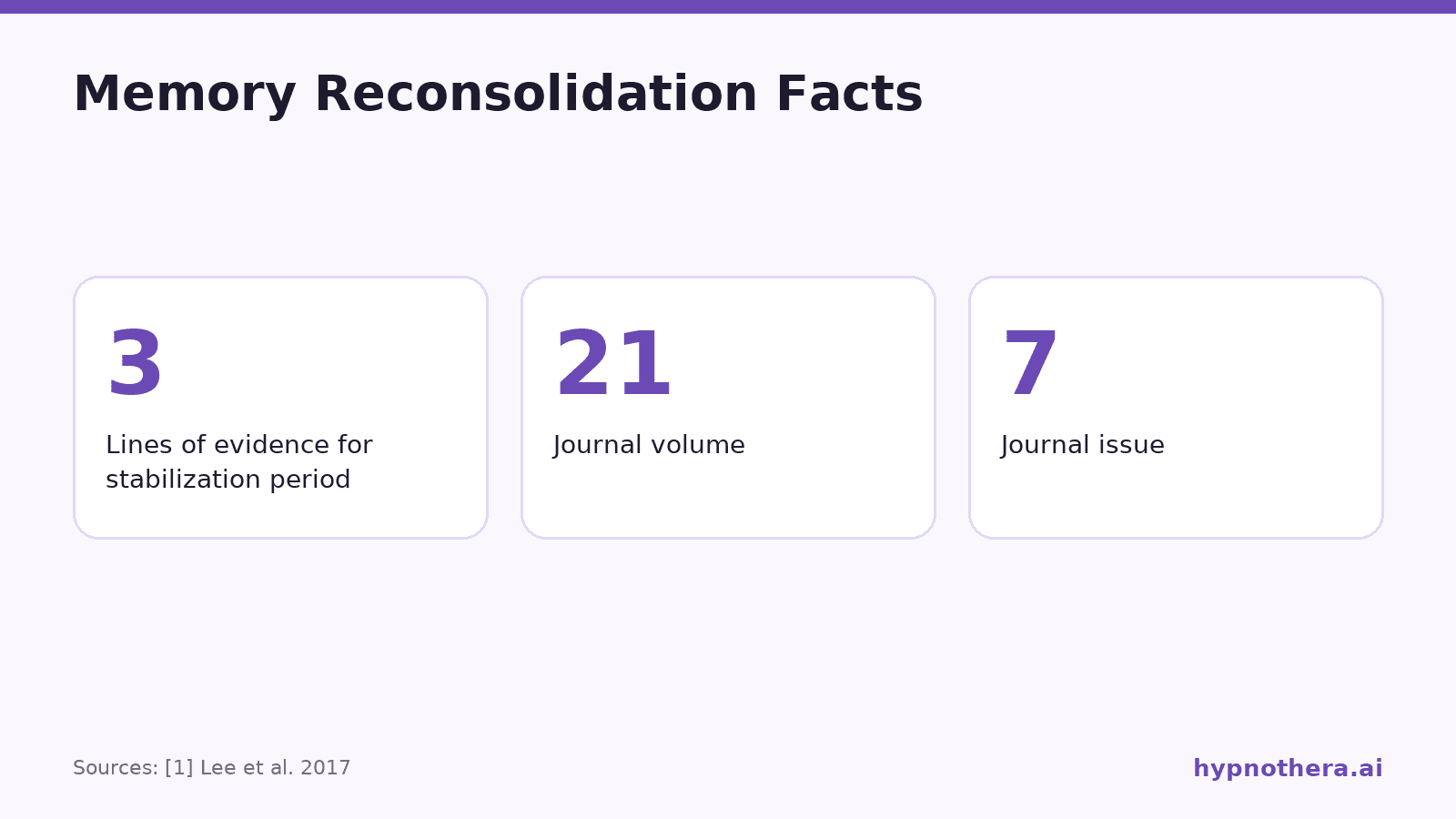
Three lines of evidence support the existence of a stabilization period on the order of hours after the acquisition of new memories [1]. First, performance can be impaired if amnesic treatments are given after learning. Second, performance can be impaired if new competing learning occurs after the initial learning. Third, retention can be enhanced by administration of various compounds after the initial learning [1]. Critically, all three manipulations are effective only when given soon after new learning and not when given after a delay [1]. The same three lines of evidence point towards the existence of a post-retrieval restabilization period [1]. This means the brain has a specific window of time where it is actively rebuilding the memory, and this is when it is most open to change.
How Emotion Drives Subconscious Updating
Subconscious patterns are deeply tied to emotional signals. Research suggests that the subconscious and conscious processing of emotional signals enhances value-updating in cue-reward associations [2]. This means that the emotional weight we attach to a cue—like a time of day, a location, or a feeling—directly influences how strongly a habit is reinforced. A cue is simply a trigger, but the reward is the emotional payoff the brain anticipates.
When you encounter a familiar cue, your brain subconsciously evaluates the expected reward based on past emotional experiences. If the emotional signal is strong, the value-updating process is more robust [2]. This is why simply trying to logic yourself out of a habit often fails. You can know intellectually that doomscrolling at midnight is bad for your sleep, but the subconscious emotional association of relief or distraction is doing the heavy lifting. The brain has learned that this cue leads to that emotional reward, and it updates the value of that association every time you repeat the loop.
Think about the habit of checking your phone when you hear a notification. The notification is the cue. The reward is the dopamine hit of a new message. Every time you check your phone, the emotional signal of anticipation and novelty enhances the value-updating of that cue-reward association [2]. The brain learns that the cue is valuable and worth responding to. This is how a simple action becomes an automatic, subconscious pattern. To break the pattern, you need to update the value of the cue. You need to teach the brain that the notification is no longer worth the interruption.
To effectively update a pattern, you need to engage with the emotional component, not just the logical one. Understanding that a window exists after recall is one thing [1]. Knowing how to use it is another. The reactivated memory becomes vulnerable to interference, meaning new competing learning can occur after the reactivation to impair the old memory expression [1]. By introducing a new, positive emotional experience right after recalling the old pattern, you can begin to rewrite the cue-reward association. You are teaching the brain that the old cue now leads to a new, better feeling. This is the core of subconscious pattern updating.
Behavioral Interventions for Pattern Updating
You do not need a lab or a pharmacological agent to experiment with these ideas. In recent years, the scope of intervention has broadened into non-pharmacological, or behavioral, treatments [1]. These behavioral interventions can impair subsequent memory expression by introducing new competing learning after the reactivation of an existing memory [1]. This means you can use everyday experiences to rewrite old patterns, provided you time them correctly.
The key is timing. The manipulations are effective only when given soon after new learning or memory reactivation, and not when given after a delay [1]. This means you have a limited window after recall to introduce a new pattern. If you wait too long, the old memory re-stabilizes, and the opportunity for easy updating closes. The brain needs a specific sequence: reactivate, then update.
Here is a simple protocol based on the research [1]. The idea is to approximate the conditions of the lab in your daily life. First, you need to reactivate the old pattern. Bring to mind the specific cue and the automatic response you want to change. This places the memory into a labile state [1]. Second, immediately introduce a new, competing experience. This could be a vivid visualization of a new, healthier response, infused with a positive emotional signal [2]. The subconscious and conscious processing of this new emotional signal enhances the value-updating of the new cue-reward association [2]. Third, allow the memory to re-stabilize. By repeating this process, you are using retrieval-induced plasticity to update maladaptive memories and reduce their problematic impact [1].
The new competing learning must be strong enough to interfere with the old memory. If the new experience is weak or unconvincing, the old memory will simply re-stabilize in its original form. This is why a vivid, emotionally charged visualization is more effective than a simple logical thought. The brain needs to feel the new reward to update the value of the cue. The subconscious and conscious processing of this new emotional signal is what drives the value-updating [2].
For example, if you want to change a stress-eating habit, first recall the feeling of stress and the urge to reach for a snack. This reactivates the old cue-reward loop. Then, immediately introduce a new behavior, like taking three deep breaths and visualizing the feeling of calm control. The positive emotional signal of calm helps update the value of the stress cue [2]. Over time, the brain learns that the stress cue no longer leads to snacking, but to calm breathing. This is how you build a new automatic habit.
The Role of State in Hypnosis
This is essentially what a well-designed hypnosis session does [1]. It guides you through reactivation and updating in a controlled environment. Hypnosis helps you downshift your nervous system, narrow your attention, and vividly rehearse a specific alternative to your automatic habit. When your nervous system is calm and your attention is focused, you are better positioned to engage with the emotional components of your patterns [2].
The psychological and physiological states you enter during hypnosis can enrich the neural resources needed for memory re-storage, strengthening the new memory [1]. You are not erasing the past, but rather interweaving new experience with the triggered memory to modify future recollections [1]. In a hypnotic state, your brain is highly receptive to suggestion. This is the perfect environment for introducing the new competing learning that impairs the old memory expression [1].
By using hypnosis to update subconscious patterns, you are working with the brain's natural mechanisms for change. You are leveraging the dynamic nature of memory [1] and the power of emotional signals [2] to rewrite automatic behaviors from the inside out. Hypnosis is not about losing control; it is about gaining control over the automatic programs that run your life. It is a practical application of cognitive science, designed to help you update your subconscious patterns for better sleep, focus, and calm.
This approach is not about fighting yourself. It is about updating the software that runs your automatic behaviors. When you try to use willpower to change a habit, you are using your conscious mind to battle your subconscious mind. This is exhausting and rarely works in the long term. By using the reconsolidation window and the power of emotional signals, you are working with the subconscious mind. You are giving it a new, better program to run. This is why hypnosis is such an effective tool for habit change. It makes the process of updating subconscious patterns easier and more natural.
Key takeaways
- Memories are not fixed; they become changeable when you recall them [1].
- Emotional signals enhance the value-updating of cue-reward associations [2].
- You have a limited window after recall to introduce new, competing learning [1].
- Behavioral interventions can update maladaptive memories without drugs [1].
- Hypnosis provides an ideal state for reactivating old patterns and rehearsing new ones [1].
Ready to update your subconscious patterns? Try a custom-generated self-hypnosis session with Hypnothera to guide your brain through the reconsolidation process. Start your Hypnothera session
Sources & Further Reading
- Lee JLC, Nader K, Schiller D (2017). An Update on Memory Reconsolidation Updating. Trends in cognitive sciences. https://doi.org/10.1016/j.tics.2017.04.006
- Watanabe N, Haruno M (2015). Effects of subconscious and conscious emotions on human cue-reward association learning. Scientific reports. https://doi.org/10.1038/srep08478
Related Posts
Theta, Alpha, and Suggestibility: What EEG Reveals About Hypnosis
This article explores the research linking theta and alpha brainwaves to hypnotic suggestibility, explaining the slow wave hypothesis and its practical implications for self-hypnosis. It synthesizes findings from recent EEG studies to show how downshifting you
Why Your Brain Remembers Differently Depending on Your State
This article explores state-dependent learning and recall—how your internal physiological state during encoding affects what you can retrieve later. It covers classic alcohol studies, exercise-based state experiments, and what this means for hypnosis and habit
Memory Reconsolidation Windows: The Brain's Brief Edit Mode
This article explains how recalling a memory briefly makes it changeable, what the research actually shows about timing and interventions, and how guided hypnosis sessions can support that update process. Every research claim is cited to the provided sources.