The Alpha-Theta Bridge: What Happens in Your Brain When You Fall Asleep

You know the moment. Your thoughts start to loosen, your body feels heavier, and the sharp edges of the day begin to blur. Something is happening — but it is not a switch flipping. It is a process, and your brain is orchestrating it in real time.
I studied cognitive science at Berkeley, and I have spent a lot of time thinking about what the brain is actually doing in that liminal space between wake and sleep. It turns out that the transition has a measurable signature: your brainwaves shift from alpha rhythm, the idling hum of relaxed wakefulness, into theta rhythm, the slower cadence of early sleep. Researchers call this the alpha-theta transition, and it comes with a cascade of changes in blood flow, breathing, and attention.
If you have ever struggled to cross that bridge — lying awake while your body refuses to downshift — understanding what is happening beneath the surface can help. Not because knowledge alone puts you to sleep, but because it points you toward conditions that let the bridge form naturally. You can explore a guided sleep hypnosis session designed to support exactly this kind of downshift, or read on for the science behind it.
Sleep Onset Is a Process, Not a Switch
Clinical sleep scoring traditionally treats the wake-to-sleep transition as a binary event: you are either awake or asleep, and the moment of crossing is a single time point [1]. But the physiological evidence tells a different story. Sleep onset is a continuous, dynamic process that unfolds over time, involving simultaneous changes in brainwave activity, muscle tone, breathing, and behavioral responsiveness [1].
Michael Prerau and colleagues at Harvard and MIT developed a framework that models sleep onset as a gradual probability curve rather than a cliff edge [1]. By combining EEG recordings with a minimally disruptive behavioral task — subjects respond to quiet breathing cues — their model estimated the instantaneous probability that a person was awake at any given moment during the transition [1]. The dynamic model significantly outperformed the instantaneous-transition models implicit in standard clinical definitions [1].
Why does this matter? Because if you lie there feeling half-awake and half-asleep, you are not failing to sleep. You are in the middle of a process that your brain is actively managing. The alpha-theta bridge is the neural signature of that process, and it has distinct stages.
The Alpha-to-Theta Transition: Blood Flow, Breathing, and the Body
In a 2005 study published in The Journal of Physiology, Futoshi Kotajima and colleagues measured cerebral blood flow, ventilation, blood pressure, and cardiac activity in ten healthy subjects as they fell asleep and woke spontaneously [2]. They used transcranial Doppler ultrasound to track middle cerebral artery velocity as an index of cerebral blood flow, while simultaneously monitoring sleep state through EEG [2].
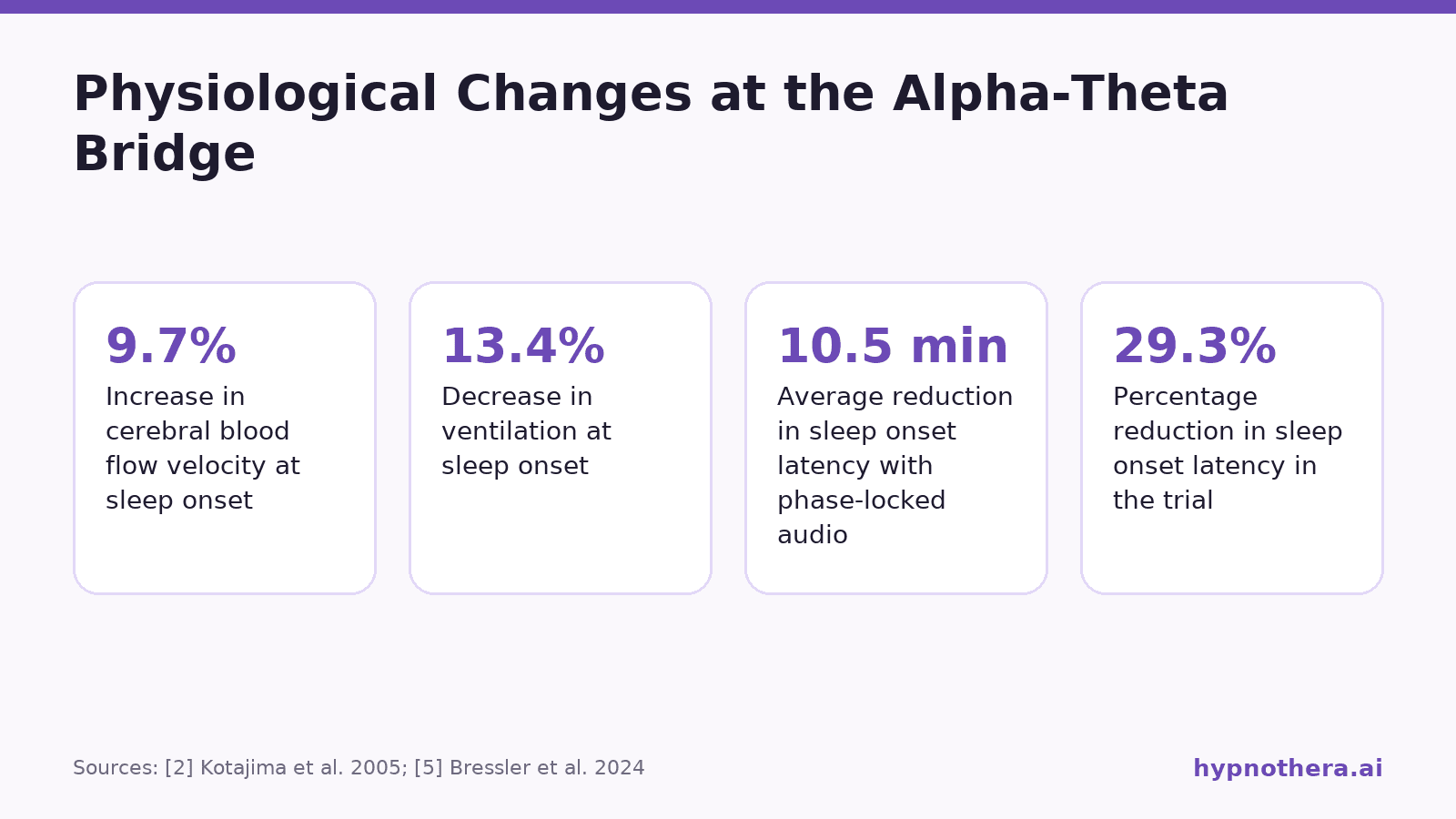
The key finding was that the transition from alpha to theta rhythm — the moment the brain shifts from wake to sleep — was accompanied by a cluster of measurable physiological changes. Ventilation decreased by 13.4% and tidal volume decreased by 12.2% [2]. End-tidal carbon dioxide increased by 1.9% [2]. Mean arterial blood pressure decreased by 3.2% [2]. And middle cerebral artery velocity increased by 9.7% [2].
When subjects spontaneously awoke — transitioning back from theta to alpha — the pattern reversed. Ventilation increased by 13.3%, tidal volume increased by 11.4%, end-tidal carbon dioxide decreased by 1.9%, and middle cerebral artery velocity decreased by 11.1% [2]. Mean arterial blood pressure decreased by 7.5% during this reverse transition [2].
The researchers noted that the changes in cerebral blood flow during sleep onset could not be attributed to changes in ventilation or blood pressure alone [2]. They speculated that the shifts in cerebral vascular tone were mediated neurally, by regulatory mechanisms linked to changes in cortical state [2]. In other words, the brain itself appears to be driving blood flow changes as it shifts gears, independent of the slower metabolic adjustments that characterize stable non-REM sleep [2].
- Alpha rhythm = relaxed wakefulness; theta rhythm = early sleep. The transition between them is the neural bridge.
- Breathing slows and deepens slightly as you cross from alpha to theta. Your body is downshifting.
- Cerebral blood flow temporarily increases at sleep onset before the longer-term reduction of stable sleep.
What the EEG Landscape Looks Like at the Bridge
A 2019 study by Gorgoni and colleagues examined the spatiotemporal pattern of EEG activity at sleep onset after a period of prolonged wakefulness [3]. They found a predominant alpha oscillatory rhythm in the pre-sleep-onset period, while theta oscillatory activity became prevalent after sleep onset [3]. This confirms the alpha-to-theta shift as a defining feature of the transition.
The study also found that the EEG at sleep onset shows a cohabitation of wake-like and sleep-like activities [3]. This is not a clean handoff. Different brain regions shift at different times: fronto-central areas synchronize earlier with an increase in slow-wave activity, theta activity diffuses across temporo-occipital regions, and alpha activity shifts from a posterior to an anterior prevalence [3]. Beta frequency decreases broadly [3].
Sleep deprivation accelerated these dynamics [3]. After a period of prolonged wakefulness, oscillatory EEG changes that usually occur later in the falling-asleep process appeared earlier [3]. Higher homeostatic sleep pressure pushed the brain to shift gears sooner, compressing the timeline of the alpha-theta bridge.
Research also indicates that sleep-onset EEG changes tend not to be evenly distributed across alpha and theta bands, suggesting fine-grained structure in how the transition unfolds [4]. The bridge is not a uniform slide from one frequency to another. It is a layered, regional process with its own internal logic.
Can You Accelerate the Bridge? A Trial of Phase-Locked Sound
If the alpha-theta transition is the gate to sleep, can we nudge it open? A 2024 randomized controlled trial by Scott Bressler and colleagues tested whether auditory stimuli timed to specific phases of a person's alpha oscillations could accelerate sleep onset [5].
The trial enrolled adults with objectively verified sleep onset latencies greater than 30 minutes [5]. Participants wore an EEG-enabled headband that delivered acoustic pulses timed to arrive anti-phase with their alpha rhythm for 30 minutes during the intervention week [5]. During the sham week, the headband silently recorded EEG [5]. Twenty-one subjects were included in the analyses [5].
The results were significant. Stimulation had a significant effect on sleep onset latency according to a linear mixed effects model (p = 0.0019) [5]. Weekly average sleep onset latency decreased by 10.5 ± 15.9 minutes, representing a 29.3 ± 44.4% reduction [5]. The wide standard deviation reflects substantial variability between individuals — some responded dramatically, others less so [5].
The authors suggested that phase-locked acoustic stimulation could be a viable alternative to pharmaceuticals for accelerating sleep onset in people with prolonged latencies [5]. This is a single trial with a modest sample, and the variability is wide, but it points to something important: the alpha rhythm is not just a passive marker of wakefulness. It may be an active lever that, when targeted precisely, can help the brain cross the bridge sooner.
Practical Implications: Setting the Stage for the Bridge
The research suggests several principles that are consistent with what we know about how the nervous system transitions from wake to sleep. Your breathing, your blood flow, and your cortical rhythm are all part of a coordinated downshift [2]. The process is continuous and dynamic, not a binary switch [1]. And the brain's predictive machinery is sensitive to cues — even auditory ones — that can influence the timing of the transition [5].
So what can you do with this? First, recognize that the alpha-theta bridge forms most easily when your body is already beginning to downshift. The 13.4% drop in ventilation at sleep onset is not something you force — it is something you allow [2]. Slow, regular breathing creates conditions that are compatible with the transition, but the transition itself is orchestrated by deeper regulatory mechanisms [2].
Second, understand that sleep pressure matters. After prolonged wakefulness, the brain compresses the timeline of sleep onset dynamics [3]. If your sleep schedule is consistent and your sleep drive is sufficient, the bridge forms faster. If you try to cross it too early — before your body has accumulated enough pressure — you may stall in alpha with no theta in sight.
Third, the Bressler trial suggests that external rhythmic cues can interact with your alpha rhythm to influence sleep onset timing [5]. While the specific phase-locked technology used in that study is not widely available, the broader principle — that rhythmic sensory input can support the downshift — is consistent with the use of guided audio, binaural beats, and hypnosis sessions designed for sleep. These tools do not force sleep. They create a context in which the bridge is more likely to form.
- Allow the downshift rather than forcing it. Your breathing will slow naturally as alpha gives way to theta [2].
- Build sufficient sleep pressure. The brain crosses the bridge faster when homeostatic drive is high [3].
- Rhythmic audio may support the transition by interacting with cortical oscillations, though evidence is preliminary [5].
- Recognize that feeling half-awake is part of the process, not a failure to sleep [1].
What Hypnosis and Guided Audio Have in Common With the Bridge
Hypnosis and sleep onset share a surprising amount of neural real estate. Both involve a narrowing of attention, a downshift in autonomic arousal, and a shift in the balance of cortical rhythms. EEG findings in hypnosis are inconsistent across studies, so I will not claim that hypnosis puts you in theta — that would overstate the evidence. But the state of focused absorption that hypnosis cultivates is at least adjacent to the liminal space where alpha begins to give way to theta.
The predictive processing framework — a leading theory, not a proven mechanism — models the brain as constantly generating predictions about incoming signals and updating when those predictions fail. In this view, hypnotic suggestion shapes the brain's priors, its baseline expectations. Sleep onset is also a prediction update: the brain predicts that it is time to let go of external vigilance and shift into internal mode. Guided audio that reinforces that prediction — through voice, rhythm, and imagery — may help the update happen more smoothly.
None of this means hypnosis or audio sessions cure insomnia or treat sleep disorders. If you have a clinical sleep problem, please consult a qualified professional. What it means is that the conditions hypnosis creates — narrowed attention, relaxed body, vivid internal focus — overlap with the conditions that let the alpha-theta bridge form. That overlap is not accidental. It is rooted in how the nervous system works.
Key takeaways
- Sleep onset is a continuous, dynamic process — not a binary switch — and feeling half-awake means you are in the middle of it [1].
- The alpha-to-theta transition comes with measurable changes in breathing, blood flow, and blood pressure that your brain orchestrates neurally [2].
- After sleep deprivation, the brain compresses the sleep onset timeline, shifting into theta sooner [3].
- A 2024 trial found that phase-locked auditory stimulation timed to alpha oscillations reduced sleep onset latency by 10.5 minutes on average, though individual responses varied widely [5].
- Guided audio and hypnosis create conditions — narrowed attention, relaxed arousal, rhythmic input — that overlap with the natural alpha-theta bridge, though they do not treat clinical sleep disorders.
If you want to experience what a guided downshift feels like, try Hypnothera's sleep hypnosis sessions — designed to support the conditions where the alpha-theta bridge forms naturally. Explore sleep sessions
Sources & Further Reading
- Prerau MJ, Hartnack KE, Obregon-Henao G et al. (2014). Tracking the sleep onset process: an empirical model of behavioral and physiological dynamics. PLoS computational biology. https://doi.org/10.1371/journal.pcbi.1003866
- Kotajima F, Meadows GE, Morrell MJ et al. (2005). Cerebral blood flow changes associated with fluctuations in alpha and theta rhythm during sleep onset in humans. The Journal of physiology. https://doi.org/10.1113/jphysiol.2005.092577
- Gorgoni M, Bartolacci C, D’Atri A et al. (2019). The Spatiotemporal Pattern of the Human Electroencephalogram at Sleep Onset After a Period of Prolonged Wakefulness. Frontiers in Neuroscience. https://doi.org/10.3389/fnins.2019.00312
- Bareham CA, Manly T, Pustovaya OV et al. (2014). Losing the left side of the world: rightward shift in human spatial attention with sleep onset. Scientific reports. https://doi.org/10.1038/srep05092
- Bressler S, Neely R, Yost RM et al. (2024). A randomized controlled trial of alpha phase-locked auditory stimulation to treat symptoms of sleep onset insomnia. Scientific reports. https://doi.org/10.1038/s41598-024-63385-1
Related Posts
Theta, Alpha, and Suggestibility: What EEG Reveals About Hypnosis
This article explores the research linking theta and alpha brainwaves to hypnotic suggestibility, explaining the slow wave hypothesis and its practical implications for self-hypnosis. It synthesizes findings from recent EEG studies to show how downshifting you
Why Your Brain Remembers Differently Depending on Your State
This article explores state-dependent learning and recall—how your internal physiological state during encoding affects what you can retrieve later. It covers classic alcohol studies, exercise-based state experiments, and what this means for hypnosis and habit
Memory Reconsolidation Windows: The Brain's Brief Edit Mode
This article explains how recalling a memory briefly makes it changeable, what the research actually shows about timing and interventions, and how guided hypnosis sessions can support that update process. Every research claim is cited to the provided sources.