The Simplest Way to Calm Your Brain: Name What You Feel

Most of us have been told to "use our words" when we're upset, and brain imaging research has begun to show why that advice has some neuroscientific basis [1]. When you name what you're feeling, something measurable happens: the amygdala, a region central to threat detection and emotional reactivity, appears to dial down its response to negative stimuli [1]. This effect — known as affect labeling — is one of the more practical bridges between lab neuroscience and everyday emotional life [1].
I studied cognitive science at Berkeley, and I'm not a clinician or a licensed therapist. What I can do is translate what the studies actually show into something you can try. At Hypnothera, we care about how narrowed attention and language can shift your state — and you can explore more about what the brain does when it quiets down in our guide on the default mode network and hypnosis.
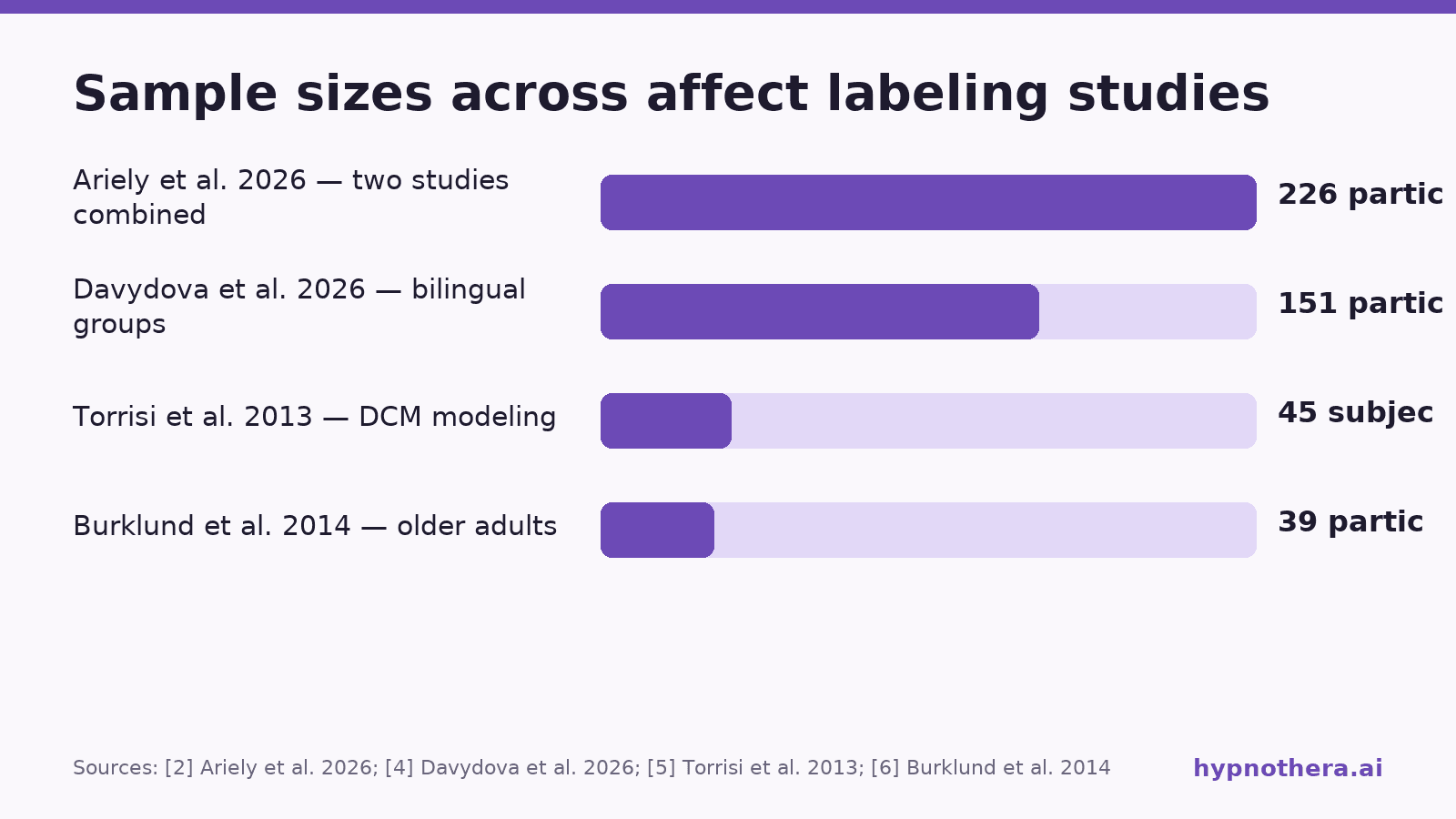
But the research story isn't simple. The mechanisms underlying affect labeling remain unclear, with studies yielding contradictory results [2]. Individual studies in this area have used samples ranging from 26 to 226 participants [2][3], so the evidence base is still developing. Recent findings about bilingualism suggest the effect depends heavily on which language you use [4][3], and newer work suggests that labeling emotions can sometimes interfere with other regulation strategies [2]. Let's walk through what the evidence actually shows — and what it means for something you might try in under a minute.
What Affect Labeling Does in the Brain
The foundational fMRI study came from Lieberman and colleagues in 2007 [1]. Participants looked at negative emotional images and either labeled the emotion shown or matched the image to a non-emotional label as a control condition [1]. When participants put feelings into words, amygdala activity was diminished compared to the control condition, and other limbic regions showed reduced responses as well [1]. At the same time, a specific prefrontal area — right ventrolateral prefrontal cortex (RVLPFC) — became more active [1]. The two were inversely correlated: more RVLPFC activity was associated with less amygdala activity, and this relationship appeared to be mediated by medial prefrontal cortex [1].
In plain terms, naming the emotion seemed to recruit a part of the brain involved in language and regulation, which was linked to reduced reactivity in a region associated with alarm [1]. The researchers proposed a pathway running from RVLPFC through MPFC to the amygdala [1].
Torrisi and colleagues extended this work using dynamic causal modeling, a method designed to infer directional influence between brain regions [5]. In a sample of 45 healthy subjects, they compared 64 models and found that the dampening influence on the amygdala originated from Broca's area but much more strongly from right vlPFC [5]. This suggests the prefrontal region may be actively inhibiting the amygdala rather than just co-activating with it [5].
A follow-up by Burklund and colleagues in 2014 compared affect labeling directly with reappraisal — the intentional strategy of reframing a situation to change how you feel about it [6]. In a sample of 39 healthy older adults, both strategies produced similar decreases in amygdala activity and similar reductions in self-reported distress [6]. Affect labeling actually produced stronger prefrontal responses than reappraisal in direct comparisons [6]. The researchers concluded that incidental and intentional emotion regulation may share overlapping neural processes [6].
It Works Without You Trying
Here's where things get interesting. Lieberman's 2011 study of four experiments found that affect labeling reduced self-reported distress as effectively as both reappraisal and distraction [7]. But participants didn't believe it would work — even after experiencing the dampening effect firsthand, they predicted that labeling would increase distress in the future [7]. This is why researchers describe affect labeling as an "incidental" emotion regulation process: the calming happens as a byproduct, not because you're consciously trying to calm down [7][6].
The same study also found that affect labeling didn't just reduce negative feelings — it dampened positive ones too [7]. When participants labeled positive emotional images, they reported less pleasure compared to simply watching [7]. This suggests affect labeling tends to dampen affective responses in general, rather than specifically targeting negative emotions [7].
That finding has a practical implication. If you're trying to savor a joyful moment, labeling the emotion might take the edge off your enjoyment [7]. The effect seems to be a broad damping, not a selective anti-distress tool.
The Language You Use Matters
Newer research has added a boundary condition that the earlier studies didn't consider. Davydova and colleagues tested affect labeling in bilinguals — two groups (Spanish-English and Spanish-Catalan) totaling 151 participants [4]. They found that labeling reduced amygdala activity only in the dominant, native language [4]. In unbalanced bilinguals, the effect appeared in the native language but not in the second language [4]. And surprisingly, balanced bilinguals showed no amygdala down-regulation in either language [4]. The difference in amygdala activity between languages was larger with reduced use of the second language [4].
Vives and colleagues found a similar pattern in a smaller study of 26 unbalanced bilinguals [3]. Labeling emotions in a foreign language not only failed to reduce amygdala activation — it evoked higher activation than labeling in the native language [3]. The researchers concluded that foreign language processing undermines affect labeling [3].
Together, these findings suggest that the fluency and emotional resonance of the words you use may be critical to the regulatory effect [4][3]. When the labeling feels effortful or emotionally distant, the amygdala dampening may not occur — and may even reverse [4][3]. The researchers propose that current theories of affect labeling need to account for language experience as a boundary condition [4].
A Clinical Signal Worth Watching
In 2024, Burklund and colleagues published an open-trial pilot study testing a brief, computer-based affect labeling intervention in U.S. veterans with combat-related PTSD [8]. Twenty veterans with PTSD and twenty trauma-exposed healthy controls completed pre-intervention assessments including fMRI [8]. Veterans with PTSD showed significantly higher PTSD symptoms, depression symptoms, and amygdala reactivity to trauma cues than the control veterans [8]. Thirteen veterans with PTSD completed the affect labeling intervention, and those completers showed reduced PTSD symptoms — and those symptom reductions were correlated with reductions in amygdala reactivity [8].
The researchers describe this as a proof-of-concept study that suggests affect labeling training offers potential as a novel, cost-effective intervention [8]. It is a small, open-trial pilot study without a randomized control group for the intervention itself, so it cannot establish whether affect labeling is an effective treatment for PTSD [8]. For clinical concerns including PTSD, always consult a qualified professional.
Limits and Contradictions
The picture has complications. Ariely and colleagues, in a 2026 study with 226 total participants across two experiments, found that affect labeling actually reduced the effectiveness of subsequent reappraisal [2]. Participants either passively observed, labeled affect, reappraised, or combined labeling and reappraisal while viewing 24 negatively valenced images [2]. Those who labeled before reappraising showed reduced reappraisal effectiveness [2]. The researchers replicated and extended findings from Nook et al. (2021) [2]. Follow-up measurements one to two days later did not show delayed positive effects — instead, responses returned to baseline [2].
The researchers suggest that affect labeling may solidify emerging emotions and limit the flexibility of subsequent emotion regulation [2]. This is a meaningful nuance: labeling isn't always additive with other strategies, and in some contexts it might make it harder to reframe what you're feeling [2]. The effects of affect labeling and reappraisal appear to diminish over time rather than building [2].
How to Try It
Here's what the evidence supports, applied practically. The studies below used specific emotion words in lab settings, and the effects were measured with brain imaging and self-report [1][7]. Here is how you might translate that into something you do at your desk, before bed, or in a tense moment.
- Name the emotion specifically. Say "I'm feeling anxious" rather than "I feel bad." The labeling studies used specific emotion words, and the amygdala reduction was observed in that condition [1].
- Use words that feel fluent and automatic to you. The bilingualism research shows that when labeling feels effortful or emotionally distant, the amygdala dampening may not occur [4][3].
- Don't expect it to replace other strategies. Affect labeling may reduce the effectiveness of subsequent reappraisal [2], so if you need to reframe a situation, consider doing that first.
- You don't need to believe in it. Participants didn't expect labeling to reduce distress, yet it did [7]. The effect appears to be incidental — it happens whether or not you intend it.
- Be aware that it may dampen positive emotions too [7]. If you want to savor something good, labeling might take the edge off.
Key takeaways
- Affect labeling — putting feelings into words — is associated with reduced amygdala activity and reduced self-reported distress across multiple studies [1][7].
- The effect appears to involve a pathway from right ventrolateral prefrontal cortex through medial prefrontal cortex to the amygdala [1][5].
- It works comparably to intentional strategies like reappraisal and distraction, even though people don't expect it to [7][6].
- The effect seems to require a dominant, emotionally fluent language; second-language labeling may not reduce amygdala activity [4][3].
- Affect labeling may interfere with subsequent reappraisal, so it is not always additive [2].
If labeling emotions in the moment feels like a useful tool, you might also enjoy a guided session that helps your nervous system downshift first — making it easier to notice and name what's actually there. Try Hypnothera's guided sessions
Sources & Further Reading
- Lieberman MD, Eisenberger NI, Crockett MJ et al. (2007). Putting feelings into words: affect labeling disrupts amygdala activity in response to affective stimuli. Psychological science. https://doi.org/10.1111/j.1467-9280.2007.01916.x
- Ariely Y, Mokady A, Reggev N et al. (2026). Affect Labeling and Reappraisal as an Emotion Regulation Strategy. Affective science. https://doi.org/10.1007/s42761-026-00362-z
- Vives ML, Costumero V, Ávila C et al. (2021). Foreign Language Processing Undermines Affect Labeling. Affective science. https://doi.org/10.1007/s42761-021-00039-9
- Davydova T, Marin Marin L, Cherednichenko A et al. (2026). Affect labeling down-regulates amygdala only in a dominant native language. Proceedings of the National Academy of Sciences of the United States of America. https://doi.org/10.1073/pnas.2603126123
- Torrisi SJ, Lieberman MD, Bookheimer SY et al. (2013). Advancing understanding of affect labeling with dynamic causal modeling. NeuroImage. https://doi.org/10.1016/j.neuroimage.2013.06.025
- Burklund LJ, Creswell JD, Irwin MR et al. (2014). The common and distinct neural bases of affect labeling and reappraisal in healthy adults. Frontiers in psychology. https://doi.org/10.3389/fpsyg.2014.00221
- Lieberman MD, Inagaki TK, Tabibnia G et al. (2011). Subjective responses to emotional stimuli during labeling, reappraisal, and distraction. Emotion (Washington, D.C.). https://doi.org/10.1037/a0023503
- Burklund L, Davies C, Niles A et al. (2024). Affect labeling: a promising new neuroscience-based approach to treating combat-related PTSD in veterans. Frontiers in Psychology. https://doi.org/10.3389/fpsyg.2024.1270424
Related Posts
Theta, Alpha, and Suggestibility: What EEG Reveals About Hypnosis
This article explores the research linking theta and alpha brainwaves to hypnotic suggestibility, explaining the slow wave hypothesis and its practical implications for self-hypnosis. It synthesizes findings from recent EEG studies to show how downshifting you
Why Your Brain Remembers Differently Depending on Your State
This article explores state-dependent learning and recall—how your internal physiological state during encoding affects what you can retrieve later. It covers classic alcohol studies, exercise-based state experiments, and what this means for hypnosis and habit
Memory Reconsolidation Windows: The Brain's Brief Edit Mode
This article explains how recalling a memory briefly makes it changeable, what the research actually shows about timing and interventions, and how guided hypnosis sessions can support that update process. Every research claim is cited to the provided sources.