Your Brain Predicts Before It Perceives: How Priors Shape Reality

You probably assume your eyes passively report what is in front of you. They do not. Your brain generates a prediction about what you are about to see, then checks that prediction against incoming sensory data and updates only when something does not match. What you experience as reality is the brain's best guess, not a direct readout of the world.
This idea, called predictive processing, has become one of the most influential frameworks in cognitive science. It reframes perception, emotion, and even social judgment as forms of inference shaped by prior knowledge. Understanding how priors work gives you a lever for changing automatic habits, because the same mechanism that makes you see an illusion also makes you reach for your phone without thinking.
If you want to update an automatic behavior, you need to understand what prior your brain is running and how to give it a better prediction to rehearse.
If you would like a guided way to practise this, Hypnothera has audio sessions built around the same ideas.
What Predictive Processing Actually Says
The core claim of predictive processing is that the brain is not a passive receiver of sensory information. Instead, it continuously generates top-down predictions about incoming sensory signals and compares them with bottom-up sensory input. When the two match, perception is efficient and feels effortless. When they do not match, the brain produces a prediction error and updates its internal model [1].
This framework draws on ideas stretching back to Hermann von Helmholtz, who proposed that perception involves unconscious inference based on past experiences [2]. The modern version, developed by Karl Friston, Andy Clark, and others, formalizes this as a hierarchical Bayesian process where each level of the cortical hierarchy sends predictions downward and prediction errors flow upward [1].
The brain's goal, in this framework, is to minimize prediction error over time. It does this by either updating its predictions to match the world or by acting on the world to match its predictions. This second route, called active inference, links perception directly to action [1].
Priors: The Knowledge That Shapes Perception
A prior is simply the brain's existing expectation about what is likely to happen next. Priors come in different timescales and scopes. Long-term priors are built from years of accumulated experience, like knowing that cars belong on roads and birds belong on tree branches [3]. Short-term priors emerge from immediate context, like expecting a door to open when someone reaches for the handle [4].
Research by Özen and colleagues examined how these two types of priors interact during visual perception of actions. Participants watched animated human and robot agents performing biological or mechanical motion, with cues providing either form-based or motion-based short-term priors. The results showed that long-term priors guided perceptual decisions when stimuli were congruent with them. When expectations were violated, the brain shifted its weighting toward motion-based short-term cues while form-based cues contributed minimally [4].
This reveals something important: the brain does not treat all priors equally. It assigns precision, a kind of confidence weight, to different sources of information depending on context. When long-term expectations fail, the system dynamically reweights which priors to trust [4].
- Long-term priors: stable expectations from years of experience (cars on roads, birds in trees)
- Short-term priors: contextual expectations from the immediate situation (someone reaching for a door)
- Precision weighting: the brain adjusts how much it trusts each prior based on how reliable it has been recently
How Priors Shape What You See
Object and scene perception illustrates priors in action. When you glance at a kitchen, you do not identify each object independently. Your brain uses scene-level priors to constrain what objects it expects to find, and object-level priors to constrain what scene you are likely in. A toaster on a counter confirms the kitchen hypothesis, which in turn sharpens expectations for other kitchen objects [3].
Peelen and colleagues describe this as joint probabilistic inference, where best guesses about objects act as priors for scene perception and vice versa. The two pathways operate partly in parallel, allowing a rapid initial gist of both objects and scenes concurrently, then bidirectional interactions refine both [3].
This is why you can recognize a familiar room from a brief glimpse but struggle to find a specific object in an unfamiliar one. Your priors are doing most of the work in the first case and fighting against you in the second.
Priors in Social Perception and Bias
Priors extend beyond objects to people. McGovern and colleagues argue that hierarchical predictive processing provides a framework for understanding how social context and group-based knowledge directly shape intergroup perception [5]. The same mechanism that helps you predict where a car will go helps you predict what a person will do, but it also carries stereotypes.
When you meet someone new, your brain generates predictions based on prior social knowledge, including group memberships. These priors can speed up social processing but also introduce systematic biases. The framework explains why stereotypes are resistant to change: they are priors that have been assigned high precision through repeated reinforcement [5].
Updating these priors requires generating prediction errors that are large enough to force the system to reweight its expectations. A single counterexample may not suffice if the prior has high precision. This is why intergroup bias is so persistent and why structured, repeated exposure to disconfirming evidence matters [5].
Priors and Emotional Experience
Lee and colleagues apply predictive processing to affective neuroscience, challenging the old assumption that specific brain regions uniquely decode emotional dimensions like valence and arousal. Instead, they argue that emotional experience emerges from predictive models that are not uniform across context, not specific to unique circuits, and not easily generalizable [6].
This means your emotional experience is not a simple readout of what your body is doing. It is your brain's inference about what your bodily signals mean given the current context and prior expectations. The same racing heart can be experienced as excitement at a party or panic in a dark alley depending on which prior the brain applies [6].
This has direct implications for how you work with emotional states. If emotion is inference shaped by priors, then changing the context or the prior changes the experience. This is one reason guided imagery and suggestion can shift how a bodily sensation feels without changing the sensation itself.
The Evidence Base: Strong but Still Developing
Walsh and colleagues reviewed the neurophysiological evidence for predictive processing and found a growing body of human and nonhuman research supporting its key claims, though they note that methodological challenges remain in testing some of the framework's more specific predictions [7].
Bubic and colleagues similarly note that while many researchers agree on the central importance of prediction in cognitive and neural processing, there is less agreement on terminology, definitions, and mechanisms. They conclude that a unified theory of predictive processing still needs to resolve several open issues before it can be fully established [8].
Corlett and colleagues frame predictive processing as a grand unifying theory of mind and brain function, but acknowledge legitimate criticisms. They argue an important test is its utility in accounting for individual differences, including psychopathology, where symptoms can be understood as departures from normal parametric estimates [2].
The framework is best treated as a leading theory, not a settled fact. It provides a powerful lens for understanding perception, cognition, and action, but the details of how predictions and prediction errors generate subjective experience are still being worked out [6].
Using Priors to Update Automatic Habits
Here is the practical core. Habits are context-cued automatic behaviors, and predictive processing explains why: a habit is a prior that has been assigned high precision through repeated reinforcement. When the context cue appears, the brain generates the predicted behavior automatically because the prediction error of not doing it has been minimized over time [1].
Willpower fails when you argue with a prior that has high precision. The brain treats the habit as the most likely prediction and generates it before conscious control can intervene. The fastest way to update an automatic behavior is to give the brain a vivid, specific alternative prediction to rehearse while the nervous system is in a downshifted, receptive state [1].
This is where self-hypnosis enters. A hypnotic induction narrows attention and lowers the precision on competing priors, creating a window where a new prediction can be installed with less resistance. The brain then treats the rehearsed alternative as a prior the next time the context cue appears [1].
State precedes story. You cannot argue a habit away. You can, however, give the brain a better prediction to run.
- Identify the prior: what does your brain currently predict will happen in this context?
- Generate a specific alternative: what should happen instead, in sensory detail?
- Rehearse while downshifted: use relaxation or hypnosis to lower competing priors
- Repeat until the new prediction has higher precision than the old habit
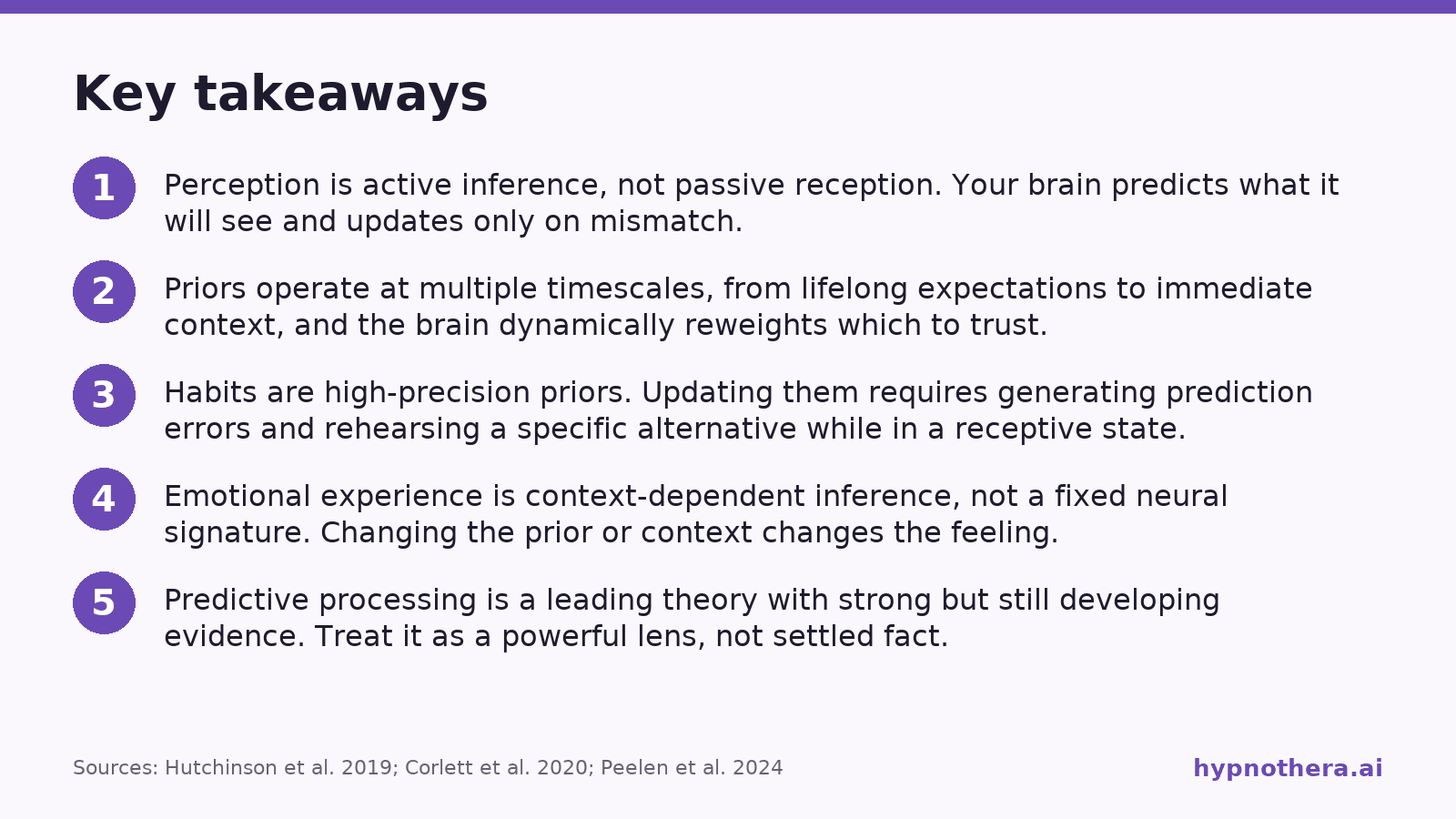
Key takeaways
- Perception is active inference, not passive reception. Your brain predicts what it will see and updates only on mismatch.
- Priors operate at multiple timescales, from lifelong expectations to immediate context, and the brain dynamically reweights which to trust.
- Habits are high-precision priors. Updating them requires generating prediction errors and rehearsing a specific alternative while in a receptive state.
- Emotional experience is context-dependent inference, not a fixed neural signature. Changing the prior or context changes the feeling.
- Predictive processing is a leading theory with strong but still developing evidence. Treat it as a powerful lens, not settled fact.
If you want to put this into practice, try a guided hypnosis session designed to help you identify and update the priors driving a specific habit you want to change. Explore hypnosis for procrastination
Sources & Further Reading
- Hutchinson JB, Barrett LF (2019). The power of predictions: An emerging paradigm for psychological research. Current directions in psychological science. https://doi.org/10.1177/0963721419831992
- Corlett PR, Mohanty A, MacDonald AW (2020). What we think about when we think about predictive processing. Journal of abnormal psychology. https://doi.org/10.1037/abn0000632
- Peelen MV, Berlot E, de Lange FP (2024). Predictive processing of scenes and objects. Nature reviews. Psychology. https://doi.org/10.1038/s44159-023-00254-0
- Özen G, Urgen BA (2026). Predictive processing in visual perception of actions: The modulation of short-term priors by the long-term prior. Journal of vision. https://doi.org/10.1167/jov.26.7.10
- McGovern H, Otten M (2024). Priors and prejudice: hierarchical predictive processing in intergroup perception. Frontiers in Psychology. https://doi.org/10.3389/fpsyg.2024.1386370
- Lee KM, Ferreira-Santos F, Satpute AB (2021). Predictive processing models and affective neuroscience. Neuroscience and biobehavioral reviews. https://doi.org/10.1016/j.neubiorev.2021.09.009
- Walsh KS, McGovern DP, Clark A et al. (2020). Evaluating the neurophysiological evidence for predictive processing as a model of perception. Annals of the New York Academy of Sciences. https://doi.org/10.1111/nyas.14321
- Bubic A, von Cramon DY, Schubotz RI (2010). Prediction, cognition and the brain. Frontiers in human neuroscience. https://doi.org/10.3389/fnhum.2010.00025
Related Posts
Theta, Alpha, and Suggestibility: What EEG Reveals About Hypnosis
This article explores the research linking theta and alpha brainwaves to hypnotic suggestibility, explaining the slow wave hypothesis and its practical implications for self-hypnosis. It synthesizes findings from recent EEG studies to show how downshifting you
Why Your Brain Remembers Differently Depending on Your State
This article explores state-dependent learning and recall—how your internal physiological state during encoding affects what you can retrieve later. It covers classic alcohol studies, exercise-based state experiments, and what this means for hypnosis and habit
Memory Reconsolidation Windows: The Brain's Brief Edit Mode
This article explains how recalling a memory briefly makes it changeable, what the research actually shows about timing and interventions, and how guided hypnosis sessions can support that update process. Every research claim is cited to the provided sources.