Your Motor Cortex Rehearses Without Moving — Here's How to Use It

Mental rehearsal isn't just visualization tricks for athletes. When you mentally practice a movement, your brain activates some of the same neural circuits it uses to actually perform that movement. This isn't a metaphor — it's measurable brain activity in the same regions that control your muscles.
I studied cognitive science at Berkeley, and one of the most fascinating things I learned is how thin the line is between thinking about doing something and actually doing it. The motor cortex doesn't always wait for your muscles to move. Sometimes it rehearses in place, firing patterns that look remarkably similar to the real thing.
This has practical implications far beyond sports. If you're preparing for a presentation, a difficult conversation, or any performance under pressure, understanding how mental rehearsal works in the brain can help you use it more deliberately. You can try a guided mental rehearsal session to experience the mechanism for yourself.
The Shared Neural Machinery
In 2004, a landmark study published in Nature by Cisek and colleagues demonstrated something remarkable about the dorsal premotor cortex — a region involved in planning and executing movements. They found that when monkeys observed sensory events associated with a well-learned motor task, most task-related neurons in this region exhibited the same activity patterns during observation as they did during actual performance [1].
This happened even during an instructed-delay period, before any actual observed motion took place. In other words, the neurons were rehearsing the movement before there was anything to physically copy. The brain was running the motor program internally, using the same neural operations it would use to execute the action [1].
The researchers described this as a potential single-neuron correlate of covert mental rehearsal. The broader implication, supported by earlier behavioral and imaging studies, is that when humans mentally rehearse a familiar action, they execute some of the same neural operations used during overt motor performance [1].
This is why mental rehearsal feels different from daydreaming. When you vividly imagine a movement — the feel of your hand turning a doorknob, the sequence of steps in a procedure, the rhythm of a speech — you're not just thinking abstractly. You're activating motor and premotor regions that are normally used for actual performance [1]. The brain is simulating the action, not merely representing it symbolically.
What Happens in a Complex Real-World Task
The Cisek study involved monkeys and well-learned tasks. But what about complex, real-world human skills? A 2024 study by Modi and colleagues, published in Frontiers in Human Neuroscience, explored this question with surgical residents learning laparoscopic knot tying — a demanding bimanual task that requires precision, coordination, and practice [2].
Mental rehearsal, as defined in this study, is the cognitive rehearsal of a motor task without overt physical movement. The researchers noted that inadequate exposure to real-life operating rooms can impede the timely acquisition of technical competence among surgical residents, and that mental rehearsal has been shown to accelerate surgical skills learning [2].
Twelve surgical residents performed the laparoscopic knot tying task before and after either mental rehearsal or a control intervention [2]. The researchers used functional near-infrared spectroscopy, or fNIRS — a brain imaging technique that measures changes in blood oxygenation in the cortex — to assess activation in the prefrontal cortex and motor cortex during the task [2].
The choice of fNIRS is notable. Unlike fMRI, which requires lying still in a scanner, fNIRS can be worn during actual task performance. This means the researchers could measure brain activity while surgeons were actively tying knots, not just while they imagined doing so. They could compare what happened in the brain before and after mental rehearsal training [2].
The study aimed to understand the neuroplastic effect of mental rehearsal on a complex bimanual surgical task — essentially, whether mentally practicing a surgical skill changes how the brain responds when you actually perform it [2].
Why the Motor Cortex Responds to Mental Practice
The connection between these two studies tells a coherent story. The Cisek study shows that the premotor cortex doesn't strictly distinguish between observing, rehearsing, and performing — it runs similar neural programs in each case [1]. The Modi study applies this principle to a real-world skill, asking whether mental rehearsal of a complex surgical task produces measurable changes in the brain regions that govern performance [2].
This aligns with a broader principle from cognitive science: the brain's motor system is not just an output device. It's also a simulation engine. When you mentally rehearse an action, you're not sending a copy of the movement to your muscles — you're running the movement plan through the same neural machinery, just without the final execution step.
The prefrontal cortex, which the Modi study also examined, is involved in planning, attention, and executive control [2]. When you mentally rehearse, you're not only activating motor regions — you're also engaging the cognitive control systems that organize and sequence the action. This is why mental rehearsal of a complex task feels effortful. It's not passive imagination. It's active neural simulation that draws on the same planning and motor circuits as physical practice.
The practical implication is that mental rehearsal is not a substitute for physical practice, but a complement to it. The brain appears to treat mental and physical rehearsal as partially overlapping experiences, engaging shared neural substrates [1]. This is what makes mental rehearsal a legitimate training tool, not just a motivational exercise.
- Be specific and vivid. The brain's motor system responds to detailed, sensory-rich rehearsal. Vague intentions don't engage the motor cortex the way specific, embodied imagery does. Rehearse the actual movements, the sequence, the feel of the task.
- Rehearse familiar actions. The Cisek study found that the shared neural activity was strongest for well-learned tasks [1]. Mental rehearsal works best when you already have some physical experience with the action.
- Engage the planning system. Because mental rehearsal involves prefrontal regions as well as motor regions [2], structure your rehearsal. Break the task into steps. Rehearse the sequence, not just the outcome.
- Use it when physical practice is limited. The Modi study was motivated by the reality that surgical residents don't always get enough time in the operating room [2]. Mental rehearsal is most valuable when you can't physically practice.
- Pair it with a downshifted state. Mental rehearsal is most effective when your nervous system is calm and your attention is focused. Guided audio and self-hypnosis can help create those conditions.
The State That Makes Rehearsal Stick
Mental rehearsal works because the brain doesn't strictly separate thinking about a movement from performing it. But the quality of that thinking matters. If you're stressed, distracted, or mentally exhausted, your rehearsal will be shallow — more like vague daydreaming than neural simulation.
This is where state precedes the story. When your nervous system is downshifted — calm, focused, absorbed — your mental imagery becomes more vivid and more specific. You can hold the simulation longer. You can rehearse with the kind of detail that actually engages motor and premotor circuits.
Guided hypnosis and audio sessions work partly by creating this state. They narrow attention, reduce internal noise, and give you a structured scenario to rehearse. The combination of a calm nervous system and a vivid, specific mental simulation is what makes rehearsal effective — not willpower, not motivation, but the right conditions for the brain to do what it already knows how to do.
The research on mental rehearsal and the motor cortex is still developing. The Modi study involved a small sample of twelve residents [2], and the Cisek findings come from a specific experimental context with monkeys [1]. But the direction is consistent: mental rehearsal engages real neural machinery, and when used deliberately, it can be a meaningful complement to physical practice.
Key takeaways
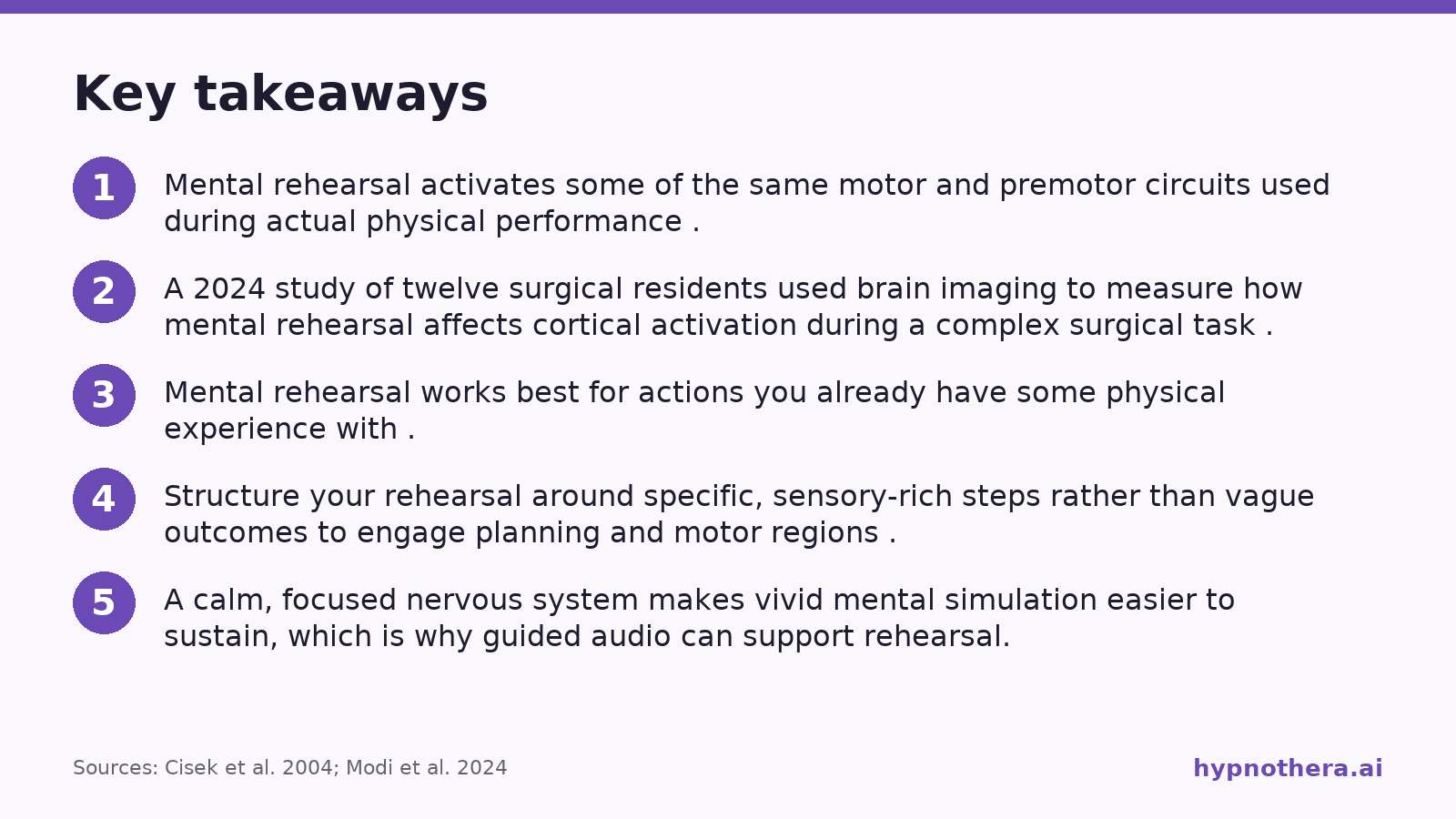
- Mental rehearsal activates some of the same motor and premotor circuits used during actual physical performance [1].
- A 2024 study of twelve surgical residents used brain imaging to measure how mental rehearsal affects cortical activation during a complex surgical task [2].
- Mental rehearsal works best for actions you already have some physical experience with [1].
- Structure your rehearsal around specific, sensory-rich steps rather than vague outcomes to engage planning and motor regions [2][1].
- A calm, focused nervous system makes vivid mental simulation easier to sustain, which is why guided audio can support rehearsal.
If you want to try this for yourself, Hypnothera has guided mental rehearsal sessions designed to help you downshift and vividly simulate the performance you're preparing for. Try a mental rehearsal session
Sources & Further Reading
- Cisek P, Kalaska J (2004). Neural correlates of mental rehearsal in dorsal premotor cortex. Nature. https://doi.org/10.1038/nature03005
- Modi H, Osborne-Grinter M, Patel R et al. (2024). Investigating the impact of mental rehearsal on prefrontal and motor cortical haemodynamic responses in surgeons using optical neuroimaging. Frontiers in Human Neuroscience. https://doi.org/10.3389/fnhum.2024.1386005
Related Posts
Theta, Alpha, and Suggestibility: What EEG Reveals About Hypnosis
This article explores the research linking theta and alpha brainwaves to hypnotic suggestibility, explaining the slow wave hypothesis and its practical implications for self-hypnosis. It synthesizes findings from recent EEG studies to show how downshifting you
Why Your Brain Remembers Differently Depending on Your State
This article explores state-dependent learning and recall—how your internal physiological state during encoding affects what you can retrieve later. It covers classic alcohol studies, exercise-based state experiments, and what this means for hypnosis and habit
Memory Reconsolidation Windows: The Brain's Brief Edit Mode
This article explains how recalling a memory briefly makes it changeable, what the research actually shows about timing and interventions, and how guided hypnosis sessions can support that update process. Every research claim is cited to the provided sources.