Your Vagus Nerve and Autonomic Regulation: What the Science Shows

Most people have heard of the fight-or-flight response. Fewer know that the body has a built-in counterbalance — the vagus nerve — which helps shift the nervous system toward rest, repair, and recovery. I studied cognitive science at Berkeley, and the more I learned about how automatic states shape behavior, the more I realized that downshifting the nervous system is often the missing step when people try to change habits or feel better.
The vagus nerve is the longest cranial nerve in the body, and it serves as the main highway for parasympathetic activity — the branch of the autonomic nervous system that promotes relaxation and repair [1]. When vagal tone is healthy, your body can return to calm after stress. When it is not, you may feel stuck in a heightened state, with a racing heart, shallow breathing, and a mind that will not slow down.
If you want a practical companion for this, our guide to the vagus nerve and autonomic regulation walks through how guided audio sessions can help you practice downshifting. In this article, I want to look at what recent research actually tells us about the vagus nerve, how it regulates the autonomic nervous system, and what that means for everyday wellbeing.
What the Vagus Nerve Actually Does
The autonomic nervous system has two main branches: the sympathetic nervous system (SNS) and the parasympathetic nervous system (PNS) [1]. The SNS prepares the body to respond to adverse situations through the fight-or-flight response, increasing heart rate, respiratory rate, blood pressure, and the production of stress hormones like cortisol [1]. The vagus nerve is the main representative of the PNS, and its functions are essentially the opposite — promoting relaxation and repair [1].
This balance is essential for regulating physiological processes and maintaining homeostasis [1]. When the system works well, the body can cope with external influences through feedback and self-regulation mechanisms [1]. When the balance tips too far toward sympathetic dominance — whether from chronic stress, illness, or other factors — the body stays mobilized for threat even when no threat is present.
Heart rate variability (HRV) is one of the most widely used non-invasive markers of vagal tone and autonomic flexibility [2]. A reduced HRV has been associated with cardiovascular diseases, hypertension, inflammation, and mental health disorders [2]. In other words, when the vagus nerve is underactive, the data shows up in the beat-to-beat variation of your heart.
Non-Invasive Vagus Nerve Stimulation: What the Studies Show
Researchers have been testing whether non-invasive vagus nerve stimulation can shift autonomic balance. One approach is transcutaneous auricular vagus nerve stimulation (taVNS), which delivers electrical stimulation through the skin of the ear, where branches of the vagus nerve are accessible.
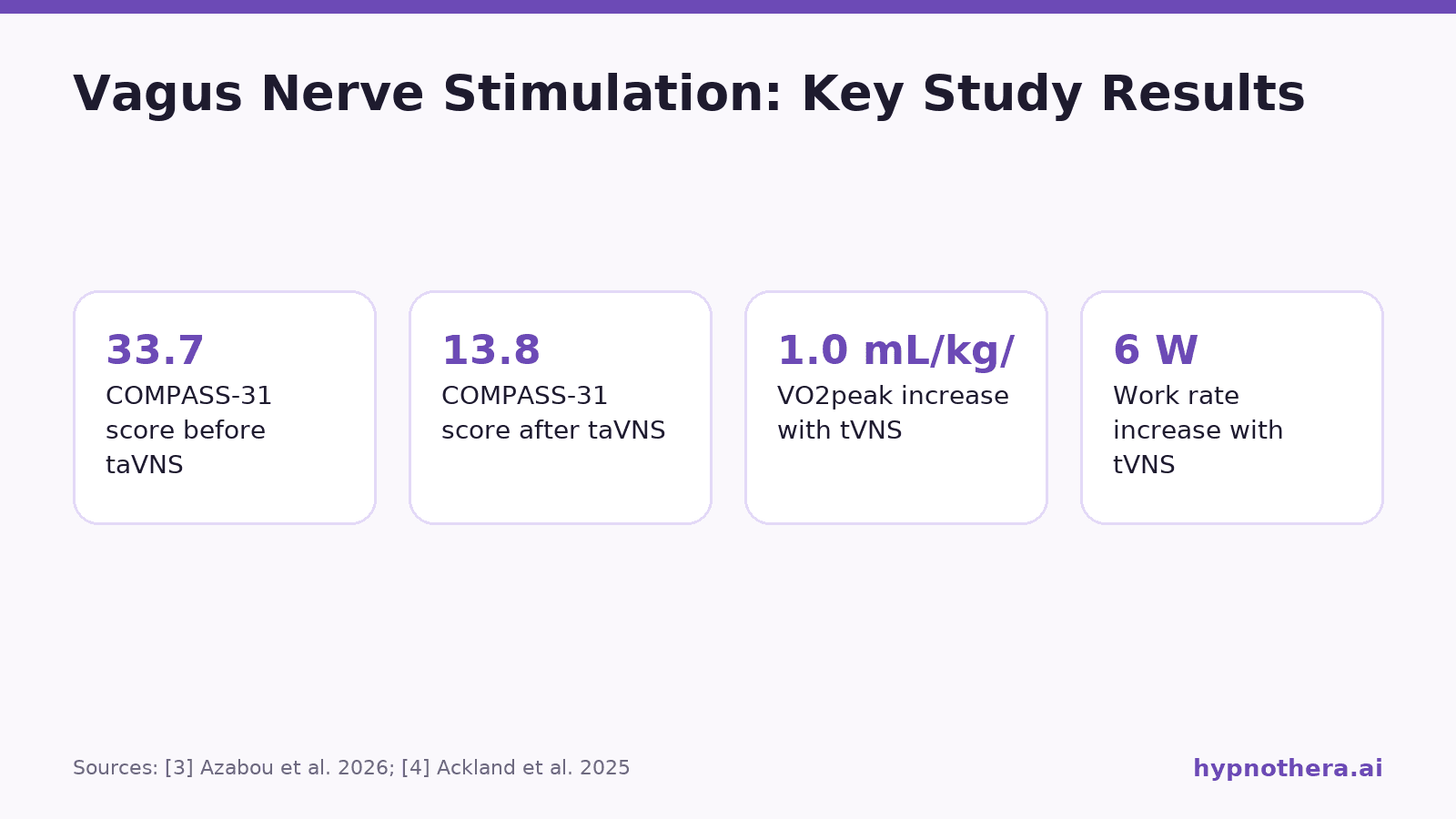
A 2026 pilot study by Azabou and colleagues tested taVNS in seventeen patients with long COVID, a condition frequently associated with persistent autonomic dysfunction, cognitive impairment, and psychological distress [3]. Patients underwent weekly one-hour sessions for eight consecutive weeks [3]. Autonomic symptoms, measured by the COMPASS-31 questionnaire, dropped from a mean of 33.71 to 13.78 (p < 0.0001) [3]. Post-traumatic stress symptoms, measured by the PCL-5, decreased from 25.76 to 19.47 (p = 0.028) [3]. Cognitive performance, measured by the COGBAT battery, improved from 37.71 to 49.41 (p = 0.011) [3]. No adverse events were reported [3].
It is important to note the limitations. This was an open-label, single-arm pilot study with only seventeen patients — no control group, no blinding [3]. The authors themselves state that these findings warrant confirmation in randomized, sham-controlled trials [3]. So while the results are promising, they are preliminary.
A 2024 randomized controlled trial by Pérez-Alcalde and colleagues took a different approach, testing whether vagus nerve neurodynamics — a manual therapy technique — could enhance parasympathetic activation in people with chronic stress [1]. Participants were randomly assigned to a group that received neurodynamics (a 6 bpm breathing protocol plus manual therapy plus a neurodynamic technique) or a group without neurodynamics (the same breathing protocol and manual therapy only) [1]. During the intervention, the neurodynamics group showed significant changes in nearly all heart rate variability variables, while the group without neurodynamics showed improvements in only a few [1]. After the intervention, the neurodynamics group maintained increased HRV, while the other group experienced a decrease — suggesting a shift back toward sympathetic activity [1].
Heart Rate Variability as a Feedback Tool
HRV biofeedback is another non-invasive approach that has gained attention. A 2025 narrative review by Gitler and colleagues discusses HRV biofeedback (HRV-B), which uses paced breathing at an individual's resonance frequency combined with real-time HRV monitoring [2]. The goal is to strengthen baroreflex sensitivity, improve autonomic balance, reduce systemic inflammation, and enhance emotional regulation [2]. The review notes that extensive research supports the efficacy of HRV-B in improving cardiovascular outcomes, managing hypertension, reducing depressive and anxiety symptoms, and fostering resilience [2].
The same review also discusses the Safe and Sound Protocol (SSP), an auditory-based intervention grounded in polyvagal theory that targets the ventral vagal complex through filtered music to promote social engagement, emotional regulation, and parasympathetic activation [2]. Preliminary studies suggest SSP may benefit individuals with autism spectrum disorder, post-traumatic stress disorder, and cardiovascular disease, but the authors note that large-scale controlled trials are needed to validate its clinical efficacy [2].
The review also acknowledges limitations such as individual variability, adherence challenges, and the need for further research [2]. Future directions include integrating wearable HRV monitoring and AI-driven adaptive biofeedback [2]. The broader takeaway is that several non-invasive strategies — breathing, auditory stimulation, and biofeedback — appear to act on the same underlying system.
Vagus Nerve Stimulation and Exercise
Exercise capacity is critically dependent on coordinated autonomic control [4]. A 2025 randomized, double-blind, sham-controlled, crossover trial by Ackland and colleagues tested whether non-invasive transcutaneous vagus nerve stimulation (tVNS) could improve exercise capacity in twenty-eight healthy volunteers [4]. Participants received bilateral stimulation of vagal auricular innervation for thirty minutes daily over seven consecutive days [4].
The results showed that tVNS increased peak oxygen consumption (VO2peak) by 1.04 mL/kg/min (95% CI: 0.34 to 1.73; p = 0.005), compared with no change after sham stimulation [4]. tVNS also increased work rate by 6 watts (p = 0.006), heart rate at peak exercise by 4 bpm (p = 0.011), and respiratory rate by 4 breaths per minute (p < 0.001) [4]. Analysis of the whole blood transcriptomic response showed that tVNS reduced the inflammatory response [4]. The authors concluded that non-invasive vagal stimulation improves measures of cardiorespiratory fitness and attenuates inflammation, offering an inexpensive, safe, and scalable approach [4].
A 2026 systematic review by Saldanha and colleagues found that current evidence suggests transcutaneous vagus nerve stimulation may influence autonomic mechanisms involved in recovery from exercise-induced stress [5]. This is an emerging area, and the evidence is still developing, but it points to a connection between vagal activity and the body's ability to recover from physical exertion.
Practical Ways to Support Vagal Tone
The research above focuses on clinical interventions, but several of the mechanisms involved — slow breathing, relaxation, and downshifting the nervous system — are things you can practice on your own. None of these are substitutes for medical care, and if you are dealing with a clinical condition, please consult a qualified professional.
Here are some practical approaches grounded in the research:
- Slow, paced breathing. The neurodynamics study used a 6 bpm breathing protocol, and HRV biofeedback research uses paced breathing at an individual's resonance frequency [1][2]. Slowing your breath to around five or six breaths per minute is a common starting point for encouraging parasympathetic activation.
- Guided relaxation and hypnosis. The core idea behind guided audio sessions is that when the nervous system downshifts, attention narrows, and the brain becomes more receptive to new patterns. This is consistent with the broader principle that state precedes story — automatic behavior is easier to update when the body is calm.
- HRV monitoring. If you have a wearable device that tracks HRV, you can use it as feedback to see how different practices affect your autonomic balance. The research on HRV biofeedback shows that real-time monitoring combined with paced breathing can strengthen autonomic flexibility [2].
- Manual therapy and bodywork. The neurodynamics study suggests that manual techniques targeting the vagus nerve may enhance parasympathetic activation, though this was a single trial and more research is needed [1].
What This Means for Everyday Wellbeing
The vagus nerve sits at the center of a system that governs how your body responds to stress, recovers from exertion, and maintains balance. The research reviewed here is still developing — much of it comes from small pilot studies, single trials, or narrative reviews [3][1][2][5][4]. But the consistent thread is that supporting vagal activity, whether through stimulation, breathing, or biofeedback, appears to shift the autonomic nervous system toward a state that promotes recovery and regulation.
For anyone interested in habit change, better sleep, or simply feeling less reactive, the practical implication is straightforward. Before trying to override your behavior with willpower, give your nervous system a chance to downshift. Slow your breathing. Use a guided session. Let the body settle. Then see what feels possible from that state.
The science is not settled, and nothing here is a cure or a treatment. But the direction of the evidence suggests that autonomic regulation is not just a background process — it is something you can actively support with simple, repeatable practices.
Key takeaways
- The vagus nerve is the main highway for parasympathetic activity, and its tone can be measured through heart rate variability [1][2].
- Non-invasive vagus nerve stimulation has shown promising results in small studies for autonomic symptoms, cognitive function, and exercise capacity, but larger controlled trials are needed [3][4].
- Slow, paced breathing at around five to six breaths per minute is a practical way to encourage parasympathetic activation [1][2].
- HRV biofeedback combines paced breathing with real-time monitoring to strengthen autonomic flexibility [2].
- Guided relaxation and hypnosis sessions can support the downshifting of the nervous system that makes habit change easier.
If you want to practice downshifting your nervous system, try a guided hypnosis session designed to support autonomic regulation and calm. Explore Hypnothera's guided sessions
Sources & Further Reading
- Pérez-Alcalde AI, Galán-Del-Río F, Fernández-Rodríguez FJ et al. (2024). The Effects of a Single Vagus Nerve's Neurodynamics on Heart Rate Variability in Chronic Stress: A Randomized Controlled Trial. Sensors (Basel, Switzerland). https://doi.org/10.3390/s24216874
- Gitler A, Bar Yosef Y, Kotzer U et al. (2025). Harnessing non‑invasive vagal neuromodulation: HRV biofeedback and SSP for cardiovascular and autonomic regulation (Review). Medicine international. https://doi.org/10.3892/mi.2025.236
- Azabou E, Pillot A, Bao G et al. (2026). Transcutaneous auricular vagus nerve stimulation improves dysautonomia, post-traumatic stress disorder and cognitive impairment in long covid patients: a pilot study. Scientific reports. https://doi.org/10.1038/s41598-026-52582-9
- Ackland GL, Patel ABU, Miller S et al. (2025). Non-invasive vagus nerve stimulation and exercise capacity in healthy volunteers: a randomized trial. European heart journal. https://doi.org/10.1093/eurheartj/ehaf037
- Saldanha L, García-Quintana M, Loro-Ferrer JF et al. (2026). Transcutaneous vagus nerve stimulation and exercise-induced autonomic regulation: a systematic review. Clinical autonomic research : official journal of the Clinical Autonomic Research Society. https://doi.org/10.1007/s10286-026-01226-z
Related Posts
Theta, Alpha, and Suggestibility: What EEG Reveals About Hypnosis
This article explores the research linking theta and alpha brainwaves to hypnotic suggestibility, explaining the slow wave hypothesis and its practical implications for self-hypnosis. It synthesizes findings from recent EEG studies to show how downshifting you
Why Your Brain Remembers Differently Depending on Your State
This article explores state-dependent learning and recall—how your internal physiological state during encoding affects what you can retrieve later. It covers classic alcohol studies, exercise-based state experiments, and what this means for hypnosis and habit
Memory Reconsolidation Windows: The Brain's Brief Edit Mode
This article explains how recalling a memory briefly makes it changeable, what the research actually shows about timing and interventions, and how guided hypnosis sessions can support that update process. Every research claim is cited to the provided sources.